

From the Handbook for Schooling the Hitler Youth
Chapter Nine: The German Culture Area (Handbook online is here)
The following has been edited for greater brevity -cy
The region influenced by German culture extends far beyond the boundaries of the German population area, far into the east of Europe. It comprises the territories of many non-Germans who, however, remained for centuries under the over-lordship of the Reich or belonged to that state of many peoples, Austria.
The German colonists flowed into the lands of eastern Europe in three great waves: the eastward migrations from the 11th to the 14th centuries inclusive; from the 17th and 18th centuries; and of the 19th century. About four million Germans now live in the Germanic regions of eastern Europe as successors to these colonists [at the time of writing - approximately 1937 -cy].
The first and second waves are distinguishable only by reason of the distance of the new settlements from the central core of the German people. The settlement of Transylvania, the Zips, the Baltic and the Gottsche go back to the time of the first eastward migration. The Zips lie in Czechoslovakia - about 42,000 Germans called Zip Saxons. In Gottche (Yugoslavia) there are 44 purely German localities with around 13,000 Germans. The Saxons of Transylvania constitute the oldest group of German nationals abroad. Around 1150 the first German settlers heeded the call of the Hungarian king, who settled them as a frontier watch against the onrushing Turks. During the period of knightly Orders, Transylvanians once more received emigrants from the Reich (1225), and after the Mongolain invasion (1241) a third stream of colonists came. For centuries the Saxons of Transylvania have lived in political independence and created their own great principality. They developed a culture on an agrarian basis and their own political consciousness, preserving their purity as a people through eight centuries. In the year 1526 they fell under Turkish over-lordship, and in 1700 came under Austro-Hungarian rule. In 1867 Transylvania merged with Hungary; since 1919 they have belonged to Rumania. The Saxons of Transylvania today number some 230,000 Germans who boldly maintain their own character.
The Baltic Germans in Estonia, Latvia, and Lithuania are a century younger. German merchants, manual workers, knights and peasants moved into the Baltic region and founded cities and towns. They gave the land its cultural imprint. Up until the middle of the 15th century the Baltic countries together with East Prussia constituted a state of German Orders belonging to the Reich. With the decline of the Orders, the Reich lost the Baltic lands. For several centuries the fight for possession of them went on between Sweden, Poland and Russia. When the three countries fell to Russia in 1793, a new age blossomed forth. German culture and a high degree of self government made these provinces the most worthwhile part of the Czarist Empire. Yet a process of Russianization set in from which the Baltic Germans had to suffer until the World War. When the Baltic states came into existence, the Germans were able, with great expenditures of money and goods, to maintain their German culture. At the present time 150,000 Germans still live in the Baltic states.
The devastation of the Thirty Years' War had increased the economic needs of the German people immeasurably. Spiritual distress due to religious and political suppression and the narrow mindedness of little states added to the suffering. Many Germans longed for better living opportunities, so when in the 17th and 18th centuries the rulers of eastern Europe called for German colonists for the purpose of better settling their regions, large bands of Germans heeded their call. They were settled in Carpathian-Russia, Kongress-Poland, Sathmar, the Bukowina, along the middle Danube and the lower Volga.
The Danube-Swabians [my ancestors, see here -cy] and the Volga-Germans were the largest group of nationals at this time.
From 1722 to 1786 the Danube-Swabians were settled along the middle Danube by the Austrian emperor. The regions wrested from the Turks—Batschka, the Banat and the Baranya—had been almost completely depopulated and destroyed during the course of long periods of warfare, and were now to be built up again by German settlers. They transformed the regions into productive, arable land and, in consequence, expanded tremendously. In contrast to the Transylvania-Saxons, however, they did not have the right of self-government, thus were seriously threatened by the danger of Magyarization when they came under the control of Hungary after its awakening. Following the World War, the Swabian region was partitioned off to Yugoslavia, Rumania and Hungary, causing their national self-consciousness to develop strong cultural associations. Today over one million Germans continue to live in the Swabian region of these states along the Danube.
The Volga Germans originated during the same period. German born Czarina, Catherine (the Great), called peasants and manual workers to Russia, settling them along the lower Volga region. To draw them there, cultural and military freedom was promised 'for all time', yet at the end of the 19th century, military freedom was done away with, causing many of these Germans to migrate to North and South America. The Volga Germans turned the unproductive steppes into the corn crib of Russia and became models for the peasantry throughout the Russian Empire. Though they were awarded political self determination and an autonomous region the size of Belgium with 500,000 German inhabitants, it has done them little good. Bolshevism fought the well-to-do as Kulaks; many were consigned to forced labor or starved in the great famine.
In Croatia-Slovenia (Yugoslavia) the Swabians along the Danube created daughter colonies in which 160,000 Germans live today. In the Dobrutscha (Rumania) 15,000 Germans dwell in 31 villages, coming from settlements in southern Russia. About 320,000 Germans are still settled today in the Wolhynian regions in Poland and Soviet Russia, although many migrated to South America.
In the 19th century German settlers also came to Bessarabia; today 76,000 Germans live in 130 Bessarabian settlements. The colonisation of Galicia by Germans began around 1772 and numbers about 60,000 today. In Bosnia, Germans are more recent, with the number about 23,000. Thus the whole of the territory of western Europe is over-set with islands of Germans.
German cultural areas in the broadest sense also comprise the compact German settlements overseas. They have come into being primarily through migrations which began after the Thirty Years' War and reached their high point during the 19th century. About six million Germans, whose descendants amount to 10 to 12 million have migrated to the United States. Only a small part of these have remained German conscious, however. Some 400,000 Germans live in Canada. As a consequence of their wide dispersion and varied antecedents, the Germans of Canada lack a closely knit cohesiveness.
In Brazil, Argentina and Chile, many German schools, German newspapers and cultural associations are maintained. 700,000 Germans live in Brazil, 200,000 in Argentina and 30,000 in Chile. There is also a large number of Germans in Australia; since 1838 some 85,000 have migrated there. Perhaps 200,000 are of German descent, although many are no long folk conscious.
Overseas Colonies
The German Reich began to acquire colonies very late … for two reasons. First the Spanish Habsburgs sat on the throne of Germany at the time of great colonial expansion. They wished to establish Catholicism as the sole religion of their empire. The Reich was entangled in bloody religious wars while Spain, Portugal, England and France won for themselves an enormous colonial empire. The German Reich got the raw end of the deal. A second reason can be found in the fact that the German Reich did not attain the cohesive unity necessary for such an enterprise until the second half of the last century. [See map of German colonies here]
In the year 1683 the Great Elector (Frederick I) conquered the territory along the Gold coast and in 1687 along the Cape of Arguin, but the attempt to establish permanent colonies did not succeed. It was Chancellor Bismarck who finally succeeded in acquiring colonial possessions. All our colonies were originally private business undertakings of German trading companies.
In this way the Bremen merchant, Adolf Luderitz, by treaty with the ruling house of the Hottentots, acquired in 1883 the Bight of Angra. In the following year he purchased additional stretches of land along the coast from the Orange River to Hottentot Bay. On April 24, 1884, Bismarck placed the territory under the protection of the German Reich. The first German colony was thereby established. Further treaties with the natives enlarged the colony to its present size. In January 1904 the Herero uprising broke out and in the fall of the same year the Hottentots revolted. By the end of 1906 peace was re-established. So German South-West Africa quickly blossomed forth: great irrigation projects, ranches, mines and flourishing little towns spread out over all the land. Before the War 13,500 Germans lived in German South-West Africa, which is twice the physical size of the Reich.
In July 1884, the explorer Dr. Nightingale was commissioned to raise the German flag in Togoland and Cameroon. Bismarck had to force the London Colonial Conference in August 1884 to recognize the three aforementioned African colonies. Cameroon was enlarged in 1911 to its present dimension.
German East Africa is due to the pioneer work of Dr. Karl Peters. At age 27 he acquired four large tracts of land. He received an imperial letter of protection from Bismarck in 1885. The final determination of boundaries followed through German-English agreement in 1890. All the land between the Indian Ocean and the three great lakes of Africa - the Victoria, Tanganyika and Niassa - was recognized as a German protectorate. Climatic conditions are favourable and permit Europeans to settle there. Large plantations sprang up from which coffee, hemp, cotton, oil seeds and spices were harvested. Before the War, 4700 Germans lived in East Africa.
Germans also acquired South Sea possessions. The German colonies were built up by great sacrifice on the part of the Reich. Their soil was not only moistened with the sweat of German planters and laborers, but watered with the blood of German soldiers. In spite of that the German people were denied the right to colonies at Versailles. The lie regarding colonies, which is refuted by the German successes and by the natives themselves, was intended merely to veil and to excuse the robbery. German East Africa fell to England; German South West Africa to the Union of South Africa. France received Cameroon, and Togoland was given to the Federation of Australia; the remaining South Sea possessions were assigned to France. To be sure, these countries received only the powers of Mandatories, so that legally the possibility exists of restoring them to the owner. The German Reich will at all events never cease to demand the restoration of its colonies.
- 1306 views
Comments (12)
I remember reading somewhere
Brian
I remember reading somewhere that in pre-1917 Russia for decades and perhaps for centuries, German immigrants (first invited by Catherine and Peter the Great) were actually highly involved in the higher government administrations in Russia and also business enterprises throughout Russia - The Russian people greatly benefited from this German involvement. Of course the Bolshevik communist revolution changed all of that for the worse.
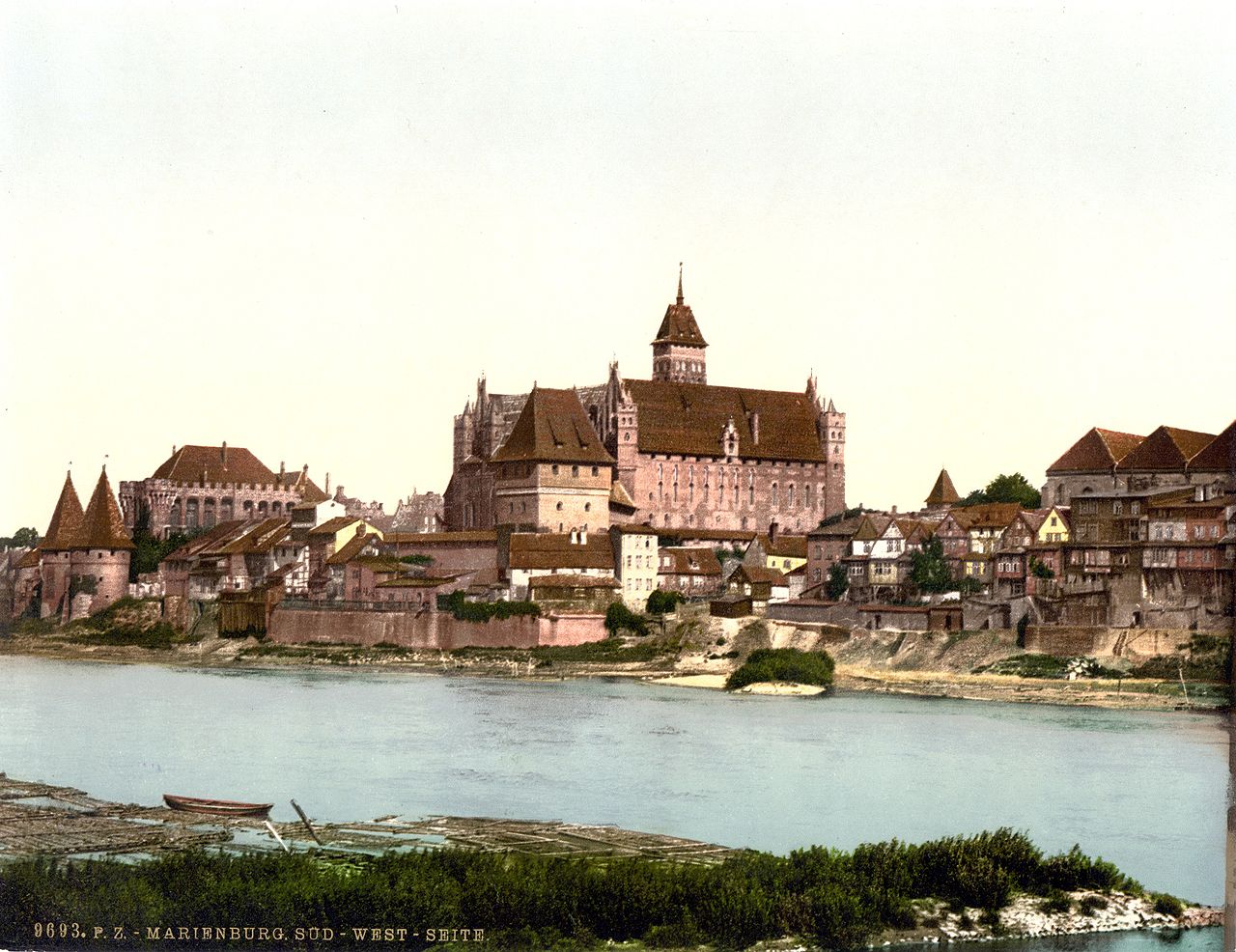
Those buildings in the picture are awesome. Germans certainly had (and still have) a knack for very smart and gorgeous looking architecture.
Dear Carolin. Are you sure
Juri
Dear Carolin. Are you sure that you don`t mess up culture with slavery . One reason, Eastern Europe is sceptic about European Union and mass immigration is the very same German "culture export" from the past. As most people know, today Germany again want to send us science and culture and proper religion, Islam in this time.
Juri, why can't you spell my
carolyn
Juri, why can't you spell my name the way I spell it? It all over this website and on the email form, yet you (and others at times) insist on spelling it your own way. It's one of those things I can't figure out, being from a different culture than you. But I think there's a certain amount of disrespect involved.
This article has nothing to do with the European Union, being written for the Hitler Jugend around 1937. Do you think the Germans of that time, and earlier, brought slavery to Eastern Europe? If so, you are truly intellectually challenged. You say that todays immigration from Africa and middle East are "the very same German culture export" as from the past." Really? Do you really think Germans, and people like me, want you to become Islamic? I would just like you to think instead of talking nonsense, and maybe if real Germans did come back to your country (Serbia?) you would have better educational opportunities than you do now. Take care.
I am very sorry for spelling
Juri
I am very sorry for spelling your name wrong. Unfortunately I am not daily reader of your website but common holy hoax denier from Baltic states, hanged around the internet for hoax updates and saw this weird headline.
If somebody spells my name wrong, I do not care. Sometimes, when I work with Britons, I teach them my proper name . Jüri. They don´t know the Ü and then I calmly explain that ü in my name means that I am führer and übermensch and enjoy the politically correct people getting angry
Forget this "culture" myth for good. Unfortunately , German colonists did not bought culture but they were very bad people for a long time and their violence, ignorance and arrogance pissed off 100 million potential allies and Germany lost 2 world wars for that.
Some Germans also do not respect German culture. In the 1944, Baltic volunteers defended the Narwa front with the bare hands. There was an a single railway line for supplies. This railway was under heavy artillery fire and kept functioning only because because of local volunteers, including my 16 years old grandfather. In the break of of artillery fire, local boys rushed to fix railway to keep trains moving.
But this was not enough. Then Baltic Germans, recruited for German Army , brought in German culture. A flogging. They flogged our youth to death for 700 years for not handling the task and and thought that this genius German culture help this time too.
Those poor young people, worked under artillery fire , lost their friends and got flogged for nothing, deserted, railway transport and entire German defence almost collapsed and commander in charge, Felix Steiner was very angry on German "culture" and some of the culture people were shot.
Please do not even think about "German "culture". Swedish do not tell us that vikings brought culture and Russian propaganda is also smart enough to avoid liberation. I do not know how to call the things Red Army brought but this was not libetry and not the culture.
Better enjoy our culture export. You could never buildt MB cars without Eastern European criminals, robbers, thiefs, murderers, drug dealers, mafia and prostitutes. So thanks to EU, we gave your culture back.
Very bad peole with very bad attitude bringing very bad things is not a culture.
I knew you were not famiiar
carolyn
I knew you were not famiiar with this website. I give you a 'A' for the Art of Victimology, but a 'D' for accurate Historiography. So which Baltic nation was your grandfather a member of in 1944, he who was flogged to death for 700 years? That's a very long time so it's hard to imagine.
I'm sorry you are so bitter but it doesn't make me change my mind about the culture Germans brought with them into the Baltic region. That was long before your grandfather's time, beginning in the 13th century.
German Influence in the East
Peter
I am in Tallinn, Estonia for peraonal busness. Estonia, like Latvia were influenced very much by the Germans that lived here for centuries. There is a saying among today's Germans - "they're more German than the Germans", which refers to how Germans used to be but may have slipped some - diligent, hardworking, etc. I didn't grow up in "old Germany" but I think in many ways Estonians are "more German than the Germans". It is a little country but they do things well here and the cities, cafes, streets and food is heavily German influenced.
I don't want to pat Germans on the back too much because then you don't give the Baltic peoples their due. But in the early 2000's I was here and an Estonian-American (originally from Estonia) told me he thought much of Estonia's success lay in the influence Germans had on the country.
Estonia is a star in a Europe that is not doing so great, but it's only a million people. The people are serious and can be unfriendly, cold. They say this themselves. Just the other day an Estonian told me "we don't like outsiders", but she was not referring to me. There are now a fair amount of non-Europeans here, something new for them. I don't know if the old Germans were "cold". That is what was often said about them until maybe the 1990's.
The Estonians (which also includes a large Russian population) are an attractive people. Many blondes and many are quite tall. The weather is not nice, except for a few months in the summer, but they have many nice cafes and other places to go into to get out of the cold. Theyhave cozy, comfortable places.
I also like talking to them. They were Germany's ally in the war and they suffered as a result of it, but most that I meet are German friendly. Many fled with the Germans in 44 or 45. When I was growing up in the US one of our neighbors was an Estonian. He was my father's friend, and the other day in a cafe I met a young woman that grew up in Sweden whose grandfather fled there at the end of the war. I knew it and said so and she confirmed it.
So, that is one more reason why I like it here. I would say they are German friendly. By contrast, I met an awful German hater in Ukraine. Many Ukrainians are friendly and they are "warm" to Estonia's "cold" but Germans, Estonians, Latvians and a few other nations have a common bond. But don't tell one of today's Germans that. They have so much self hatred they wouldn't understand. Frankly, I think many Germans know little or nothing about their own history. They know nothing of Germany's lost territories (1/3 of the country) and probably think Germany got what they deserved. I find some Germans disgusting.
Tallinn is a beautiful city.
You just forgot to mention
Gilson
You just forgot to mention the huge russian minority in Estonia causing lots of trouble! This explain why Estonia has very high crime levels compared to western countries as well as mortality rates.
Despite the discrimination Russians suffer in the baltic countries, like e.g. being denied citzenship, they don't want to go back to Russia.
A very dangerous fifith column.
Estonia
Janus
What is their attitude towards European unity?
Also, what would you say is the general consensus on Hitler in Estonia?
Estonia, EU and Hitler
Peter
Since they are a part of the EU and I've noticed a fair amount of darker people in Tallinn (including Africans) government policy indicates they are pro EU and pro unity, but at least one person told me she's concerned about the number of blacks in Estonia. I don't know peoples attitudes towards Hitler. I would guess they are mostly negative, since most of the world has been told the same thing for 75 years. I can say that 30 years after the war ended, my own German mother's attitude toward Hitler became nagative. But with the rise of the internet and revisionist history over the last 10 to 15 yeaars, I think her attitude might be more positive towards him again.
What I can say with some confidence is that generally, Estonians don't feel shame for allying themselves with Germany and fighting for their independence from the USSR. But they might also say that is why they fought alongside Germans and for no other reason.
Who in his (or her) right
Hasso C.
Who in his (or her) right mind would object to the fact that, throughout history, wherever Germans went, they built civilization? If you have a desert island and want it tidied up, just drop a bunch of random Germans there and come back a couple of years later to find a little, flourishing Reich with autobahns, volkswagens and everything.
Myself, a mix of relaxed, laissez-fairy Polishness and militaristic Prussianism, thought of myself as containing the best of both both worlds. Yet, I began to bloom for real when I met a girl from Westfalia. She taught me to work less for more and to enjoy life the way she herself does. A true testament to German effectiveness. And she is in no way self-hating, except when she gains weight.
Best regards and thanks for all your efforts here, Carolyn!
Your comments are always a
carolyn
Your comments are always a pleasure to receive. Thank you, Hasso!
German civilization
Peter
I have been thinking the same thing lately. I have seen videos of Namibia (formerly German Southwest Africa) and its capital city Windhoek is beautiful and from my limited perspective, it apprears to be doing pretty good, especially for an African country. But at least some of the blacks there are typically stupid and blame the Germans for the new theory developed over the last few decades that Germans committed genocide against them. Others hopefully are not so stupid and know why they might be doing fairly well. Of course, neighboring South Africa, which was very beautiful until black rule started in the mid 90's, is now a hell hole.