


By Carolyn Yeager, February 2011
copyright 2011 Carolyn Yeager
1949-1955: Wiesel’s movements and life-support system during these years follow an odd pattern.
In January 1949, six months after the establishment of Israel as a state, the purpose for the Irgun presence in Europe changed. Their Paris newspaper Zion in Kamf no longer being necessary, the office shut down. “Elie Farshtei and his lieutenants, Joseph [Wiesel's boss] among them, were recalled to Israel. I received no orders or aid from anyone. “Why don’t you come with us?” Joseph asked. I promised to think about it.” 11
This is problematic. Was Wiesel’s enthusiasm for Israel simply in his fantasy? The formation of Israel had seemed to mean everything to him; why would he not want to live there now it had become a reality? It was also a logical solution to his stateless status. Once again, we feel we’re not given the true picture. Was Wiesel “not recalled” with the others because he was more useful in Europe, where he could better serve the new state. He says he now returned to his “studies,” and “There were days when I was so absorbed in my reading that I never left my room. I had nothing to seek in the desert.” [Rivers, p 174]. The world around him in Paris, where he supposedly preferred to stay, he calls a “desert!” Actually Israel was a desert, not Paris. Wiesel reveals his disdain for the Gentile world, even though he takes advantage of everything it offers him.
After loafing about for awhile, his sister Hilda’s brother-in-law arranged to get him a press card, which gave him certain privileges. Wiesel worked it out with the Jewish Agency—which after Israel’s independence became the mandated organization in charge of immigration and absorption of Jews from the Diaspora—to travel to Israel. They prepared a plan for him to join a group of immigrants in May or June [1949], traveling from the train station in Lyons to Haifa. He had the idea to become a foreign correspondent for an Israeli paper.
The group happened to include a few Irgun veterans but they were leaving Europe for good, and I was ashamed to admit that I was less idealistic and above all less courageous than they. My wallet was not quite empty; a few thousand francs (my life savings) plus one pound sterling, a gift from Freddo. [P 175]
Here again, he attempts to show he is on his own, and poor, with the explanation that he can, but only barely, afford the trip. When they reach Marseilles and the sea, they go to a camp filled with Jews in transit, waiting for their passage on the ship Negba. Now he and the other Jews are in a transit camp where deprivations and close quarters are taken in stride. One man whom they asked about military service in Israel said:
Sure it’s tough, but consider this: Once I was a partisan, an underground fighter hiding in the woods like a hunted animal, not daring to come out except after dark, and now I’ll proudly wear the uniform of the Israeli army. [P 179-80]
This is a, perhaps unintended, confession of a Jewish “underground fighter” who “came out after dark” to attack the regular German troops. Wiesel comments on this, revealing his conspiratorial view of the world:
I grew up in a tradition that denies chance. Though not everything is predetermined, everything is linked. Nikos Kazantzakis (a Greek Jewish author) once said, citing an Etruscan proverb: “It is not because two clouds are joined that the spark ignites; two clouds are joined so that the spark may ignite.” Yet, free will and the possibility of choice exist. Rabbi Akiba tells us that all is foreseen, though human beings have free choice. [p180]
In other words, do events happen and result in a consequence, or is a desired consequence the cause of events happening?
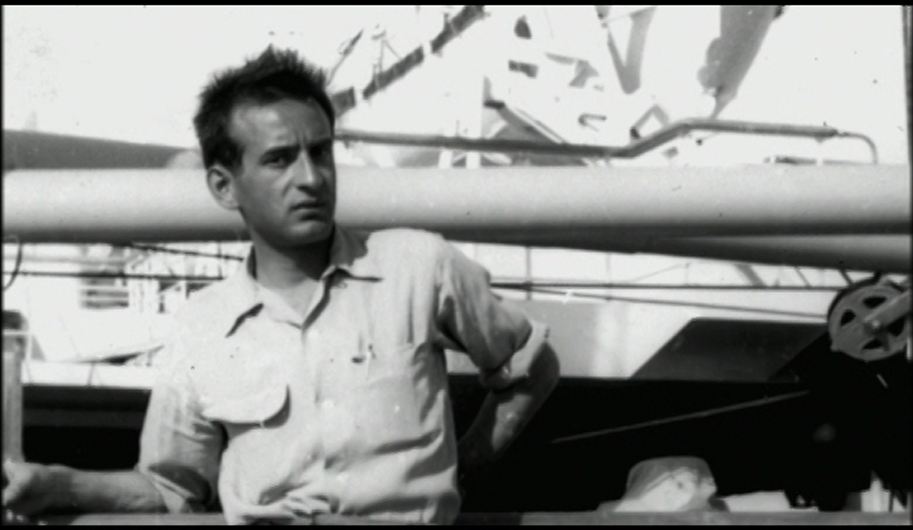
In Israel, after his initial enthusiasm, and joy in walking on the holy ground, Wiesel was disappointed over the lack of acceptance among Jews. He heard complaints and recriminations … some people said they were “not accepted”—these were the camp survivors who were seen as weak by the new Israeli “natives.”
In this atmosphere little attention was paid to the Holocaust. For many years it was barely mentioned in textbooks and ignored in universities. In the early fifties, when David Ben-Gurion and his colleagues finally decided to pass the Knesset bill creating Yad Vashem, the Holocaust Memorial, the emphasis was on courage. Resistance fighters were presented as a kind of elite, while the victims—the dead and survivors alike—deserved at best compassion and pity. The subject was considered embarrassing. [p 184]
[It's true the "Holocaust" was built up over time. Interest in it was fanned, beginning with the Adolf Eichmann show trial in 1961-62 and increasingly in the seventies, by the media and Hollywood. Elie Wiesel played a major role in establishing memorial museums, especially in Washington, DC , funded by U.S. taxpayers, playing on his theme of "Memory" with the help of influential newspapers with wide readership like the New York Times.]
Wiesel now says it was in Israel he got the idea to become a foreign correspondent. He writes that he got a recommendation to the editor of the small Yedioth Ahronoth newspaper, a Dr. Herzl Rosenblum, 12 a signatory of Israel’s Declaration of Independence as a representative of Jabotinsky’s Revisionist Zionist Irgun movement. Upon being hired by Rosenblum as the paper’s “foreign correspondent,” Wiesel sailed back to Paris on the Kedma, arriving in January 1950. [p 185]
I had lost track of Shushani 13 and Francois, but decided it would be a mistake to interrupt my studies on that account. I made a promise to myself. I vowed I would never spend less than an hour a day studying. [p 187]
Once again, it’s clear that, to Wiesel, “studying” meant reading on his own, not attending classes. Always needing to explain how he lived, he writes, “Money remained the problem. Once again, Shlomo Friedrich, my angel of mercy, managed to steer some free-lance translations and editorial work my way.” [p 188] We will see more of this type of explanation. Whenever Wiesel needs to solve the mystery of the appearance of needed cash, “free-lance” work is often the way he does it. Something to think about: Why Wiesel did not stay in Israel, among his own people who were so friendly and helpful, rather than choose to struggle in Paris as a stateless person? The most obvious answer is that he was assigned a job to do in France for the benefit of Israel. “I worked in my hotel room, a sunless cubicle overlooking the courtyard,” he writes.
In 1950, Elie Wiesel’s opportunities for travel begin … with a little help from friends
Suddenly wanting to return to Israel to talk to his new editor [or handler?] face to face, he somehow manages an appointment with a director of Zim Shipping.
I went to see a man called Loinger … a director of Zim, the Israeli shipping company. I explained … I had to go to Tel Aviv … Loinger understood immediately [!] … he picked up the phone and issued instructions …I was to be given a round-trip ticket on the Kedma that very day.[…] This crossing was very different from the last one. I had a comfortable cabin larger than my hotel room, a private shower, fruit and flowers on the table. [p 190]
This special treatment remains unexplained. Wiesel only tells us that, once in Israel, he visited with Dr. Rosenblum and became friends with his son, Dov. No discussion about his job is reported. Upon his return to Paris, “by chance” … by chance, mind you … he meets an official of the Jewish Agency who invites him on an automobile trip to Morocco. He “quickly” got an exit visa and a transit visa, “luckily” having enough photos on hand. [Are your eyebrows raised?]
But what about money? I had one month’s rent on my room saved up. I took the money, stuffed everything I owned into an old valise, and that was that. There were three of us in the car. The first stop was Marseilles, where we stayed in the transit camp near Bandol. […] Now it was Moroccans who were waiting to “ascend” to Israel. [p193]
This is the same camp he was in before. Wiesel says he questioned the Moroccans, spoke to them in fluent Hebrew of how wonderful Israel was. This little speech was enough to bring him a large tip from the camp director.
The camp director was so pleased with my little speeches that he insisted on paying me ten thousand francs (two hundred dollars). At first I refused, but I finally said thank you and put the money in my pocket. We set out for the Spanish border, I was terrified of the police and customs officials who examined my stateless person’s travel permit. Would they take me for a Communist agent, a veteran of the International Brigades? True, I could tell them I was only eight to ten years old during their filthy civil war, but did fascists know how to count?
Ouch. What to say about this? First, $200 in 1950 was the equivalent of around $1000 today. Could a camp director hand out that kind of money to a stranger for relating some feel-good stories to his transient charges? Not unless he was rich and very generous. We can only believe this story as told if we understand the camp as part of the Jewish Agency network for assisting immigration into Israel, and the “director” as something more than just a camp director. More likely, he was quite aware of journalist Wiesel, and what his needs were. Secondly, Wiesel’s extreme bitterness toward the “fascist” Catholic-Franco Spanish state is apparent here. He knows he is not dealing with Jew-friendly power and is nervous without that support. But he had no trouble and the threesome made it into Morocco.
I was dazzled by the subterranean nightlife of Tangier, a cosmopolitan city of countless entrepreneurs, from the most honest to the shadiest. [p196 - Now this is a Jew-friendly place.] … We crossed Spanish Morocco at breakneck speed and, arriving in Casablanca, encountered a blinding but somehow soothing whiteness … My traveling companions had contacts within the Jewish community. [p 197]
I bet they did. A poorly dressed Jew offered to serve Wiesel as a guide; he proved to know his way around the Jewish community, introducing Wiesel to many and varied sorts of people . One Saturday afternoon they attended a meeting at a Zionist club. Wiesel writes that after “teaching a few songs” to the local members, his traveling companion from the Jewish Agency gave him an envelope containing money that seemed “princely to me,” assuring that there were “no more money worries for two or three weeks.” [p 198]
Wiesel says he wrote articles while there, without really understanding the culture. When he returned to France, he received a telegram from ‘Ifergan,’ his guide: “Your articles aroused anger. I am now in the hospital, with a few broken ribs.” Twenty years later, Wiesel wrote in Yedioth Aronoth about this “wrong” he had inadvertently caused, and received a response from ‘Ifergan’ that contained the following:
Don’t blame yourself. I was only doing my job when I followed you. I was working for the Mossad at the time, and they told me to keep an eye on you. The chance of having my ribs broken was part of the deal.” [p 199]
Why would the Mossad want to keep an eye on our young journalist? What other reason could there be than for his protection. Did the unnamed official from the Jewish Agency invite Wiesel to come along because of his gift for telling stories in impeccable Hebrew and teaching songs to emigrating Moroccan Jews? That seems too simplistic. In any case, Wiesel is definitely a precious commodity who is never left without funds.
Now … twenty pages later, though dates are not given, Wiesel reports feeling “disillusioned with Europe” and decides to travel to India. Prior to this, he was passionately involved with the negotiations on reparations with the Konrad Adenauer government. Heading for Bonn, Germany from France, he first spent a day at Dachau, where he says he was “troubled and depressed, for the Jewishness of the victims was barely mentioned.” [p 202] He is no doubt unaware to this day that few Jews were kept at the Dachau camp. Typical Wieselism!
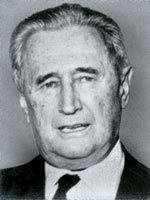
The Zionists offered him a well-paid job, with lodgings in a luxury hotel, as interpreter for Nahum Goldmann, the Polish founder and long-time head of the World Jewish Congress, at the conference of the WJC in Geneva. The Jews were deciding/debating the reparations issue among themselves. Wiesel says he was against the German reparation payments on the grounds they would lead to forgiveness or a “balancing of the shoah account.” Those in favor, such as Goldmann, argued the money for Israel was most important, while those against, including Wiesel’s former Irgun leader Menachem Begin, felt they stood on the moral high ground and would lose it by accepting financial compensation, which signaled “forgiveness.” Wiesel has always been against forgiveness. Goldmann has always been for the money, and “the Holocaust” was just another way to get it.
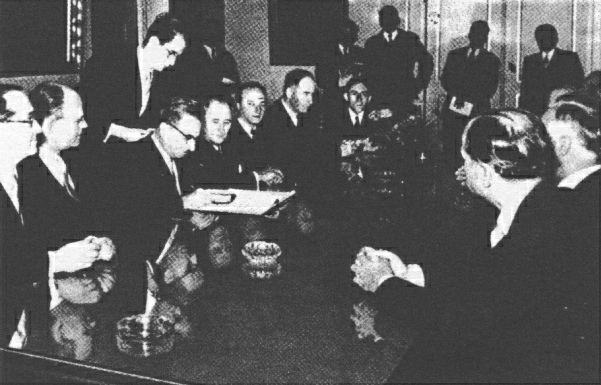
Miracles, miracles …Wiesel makes his most miraculous trip of all—a journeys to India.
I had long dreamed of visiting India, drawn to it by a desire to meet not maharajahs but sages, yogis, and ascetics … why not compare the Jewish idea of redemption with the Hindu concept of nirvana?
Travel expenses were a problem. Yedioth had no money, so I didn’t even bother asking. I wrote ten articles for various Yiddish newspapers, promised ten more for later, did a few translations, and bought a lottery ticket for the first time in my life. Miracles of miracles, I won a modest amount, and at last I had a ticket in hand, but not much more. The two hundred dollars in my wallet would not take me far. [p 223]
Lottery ticket? Isn’t that the lazy Wiesel mind again, coming up with whatever explanation comes to him without bothering whether it’s believable or not? My interpretation is that he is so confident of being protected by varying sorts of ubiquitous “Mossad agents,” even those of a volunteer status, that he doesn’t need to worry. Or is he just having fun with us? At any rate, we have here the usual nonsense. He wrote “ten articles” [nice round figure] for “various” newspapers” and promised ten more [for a cash advance?]. I ask: If he could get this work whenever he needed it, why not do it all the time and end the relative poverty he claims he was living in? Also, note the $200 figure again. This is not the last time we’ll see it.
There remained the question of a visa. Dan Avni, press attaché of the Israeli embassy … phoned his Indian colleague and settled that matter for me.
What Indian colleague is he speaking of? India didn’t establish diplomatic relations with Israel until 1992. At any rate, there was an “Indian colleague” who arranged an entry visa for Wiesel. Do you think he also got some assistance while he was there? But he never mentions anything like this; he pretends he was just helped along by miracles. It’s pretty clear, however, that he had to have some kind of unofficial business to carry out for Israel. With diplomats easing his way, he was off.
During the crossing—with stopovers in Suez and Aden—I studied English, read […] A fellow passenger […] gave me the name of an inexpensive hotel in Bombay. [p 224]
The passenger was a “medical student” who also played the ponies. He convinced Wiesel to wager some of his $200. This doesn’t sound like something Wiesel would do, but he says he did and came out even. The passenger, however, lost his money and now convinced Wiesel to lend him his $200 [to bet more!] until they reached Bombay, where he would be able to pay Wiesel back. And Wiesel did so! When they disembarked at Bombay, a very worried Wiesel searched the crowd for his “friend” and, lo and behold, he showed up with the money in hand. This is a strange story. It sounds like the yarn of an inveterate story-teller, embellishing greatly on something that in reality was far less suspenseful. At any rate, it’s definitely not one of prudence; and may be told to demonstrate his uncanny “luck.”
Wiesel wanders around Bombay, encountering begging children and orphans. He “set out in search of the country,” but reveals no plan of any kind to his readers. How far would he get on $200/$1000? Well, naturally, “a miracle” intervenes.
One day I met a rich and influential Parsi. (Seemingly sitting at an outdoor café.) We chatted about this and that, and he found something about me intriguing. (His Irgun handshake?) […] Several hours later, as he left to return to his associates, he gave me a calling card on which he had written a few words. “India is a vast country, he said. “You will undoubtedly move around a lot. With this card you can take any domestic flight to any destination.” I didn’t know how to thank him. In fact, it took only a few weeks for me to appreciate the true value of his gift. Whenever I was hungry, I would get on a plane. By then I had discovered the identity of my benefactor: He owned the airline. [p 226]
How similar this is to his experience with the Zim Shipping Lines! Wiesel throws out these stories in his 1995 memoir with little concern for how flimsy they are. He is used to people believing him and not asking bothersome questions. Again, we’re not given the name of this “Parsi” or his airline – just as we find in the concentration camp stories by Wiesel, and by many others.
I ask: How practical is it to fly from one city to the next in order to eat a meal? You end up in another place. First you have to get to the airport, wait around for the flight, board and finally be served a meal. After that, de-board the plane, wait around for your return flight and another meal, land, de-board, leave the airport and return to your lodgings. By then you will be hungry again. Were airline meals worth it? This is India in the early 1950’s—a third world country. He says he did this for “a few weeks” at least. Wiesel says a lot of foolish things, and this is just one more. He obviously had sufficient money for this trip and probably free travel arrangements made by his handlers. He is lying outrageously to his readers.
We also learn very little of substance about the country and what he did. Back in Bombay, Wiesel spends a Shabbat with a wealthy Jewish family.
I went to synagogue. My hosts proudly told me of their success. The Sassoon and the Kadouris were super-rich families, veritable dynasties. But it had never occurred to anyone to discriminate against them because of their origins or their ties to Judaism. There were so many ethnic groups, languages, cultures, and traditions in this vast country that Jews did not attract special attention. […] I returned from India even more Jewish than before. [p 228-9]
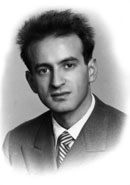
There we have it—an explanation for the Jewish drive to racially and ethnically mix all nations but their own. It is so they will not attract special attention in the Diaspora with their super-wealth. Since Wiesel sees through eyes that can only admit Jewish persecution, he is often not aware of what he’s saying, and revealing, to the rest of us who see through very different eyes. This is a paragraph that should become better known.
A few more trips—why not, they’re free.
A free ticket from El Al enabled me to visit Montreal. Bea [his younger sister] seemed happy enough; she was now working at the Israeli consulate […] I desperately wanted to ask her a question that had haunted me for years. What was it like before the selection, those final moments, that last walk with Mother and Tsipouka? It was the same with Hilda. I didn’t dare. [p 229-230]
I’ve already commented on the reasons for this in Part II of this essay. Wiesel’s next trip is to Brazil, which I also discussed previously in “Shadowy Origins of Night” in relation to the writing of his ‘first book,’ the 862-page “lost” Yiddish manuscript. However, it is relevant to the Mossad question also.
It was Spring 1954. He was going on assignment for his newspaper Yedioth Ahronoth. It seems that some Jews who had recently arrived in Israel from Eastern Europe were poor and unhappy, and the Catholic Church, according to the Zionists, was taking advantage of their unhappiness to convert them to Catholicism with offers of free passage and visas to Brazil, and $200 each. [There’s that $200 for the third time! How to explain it? Wiesel is stuck on this number.]
His editor wants him to “go and see what’s going on” with this “Catholic scam” in Brazil. His poet friend Nicholas, an Israeli citizen, would go with him. But once again he needs to explain the money. As usual, “A resourceful Israeli friend somehow managed to come up with free boat tickets for us.” [p238] Oh, those Israelis are incredibly resourceful! Wiesel remained in Brazil for two months, but he doesn’t tell us what he did there besides writing about the Jew-Catholic “scandal” and visiting people, including relatives. When he was called back to Paris to cover Pierre Mendes-France’s accession to power for his Israeli newspaper, it was mid-June 1954.
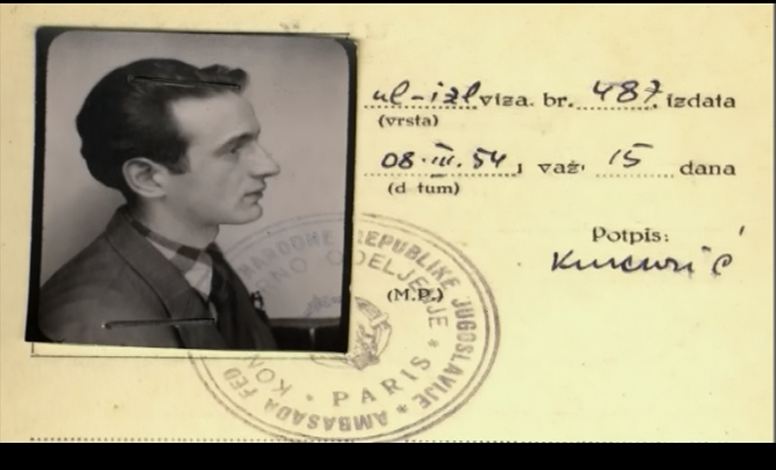
In July 1955, Wiesel makes another trip to Israel for the reason of “feeling once again the need for a change of scene.” [p 273] He went by sea and spent several weeks “making many trips through the country.” At Bnei Brak he visited the Rebbe of Wizhnitz, of his own Hasidic sect, to whom he made his famous statement that “certain things are true though they didn’t happen, while others are not, even if they did.” [p 275] That did not win him the Rebbe’s blessing.
At the end of his several-weeks stay in Israel, his editor Dov [the old man’s son] “proposed that I leave Paris and go to New York, not just to write a few articles, but as a permanent correspondent.” [p 276] Their conversation about this important decision is short and rather silly, same as with every other major event or life change that Wiesel writes about. We can easily conjecture that his Irgun/Mossad handlers thought there was now more value to be mined in New York than from his base in Paris. The German reparation talks were over, the amounts established; from now on, America was where the action was.
Next: Part IV – Déjà vu. Wiesel’s adventures in America follow the same, now-established pattern.
Endnotes:
11. Elie Wiesel, All Rivers Run to the Sea, A. Knopf, 1995, p174. [All following page numbers refer to this book]
12. Born in Kaunas in the Russian Empire (today in Lithuania), Rosenblum moved to Vienna after experiencing anti-Semitism and being prevented from studying law. In Vienna, he studied law and economics, gaining a PhD. He then moved to London, where he worked as an aide to Ze’ev Jabotinsky, a leader of the Revisionist Zionism movement. In 1935 he immigrated to Mandate Palestine and started working for the HaBoer newspaper, where he wrote under the pseudonym Herzl Vardi. In 1949, Rosenblum became editor of Yedioth Ahronoth. He remained as editor until 1986, during which time the paper became the largest selling in the country. His son, Moshe [called Dov], was later employed as editor.
13. In 1952 Chouchani left France for Israel where he remained until 1956, according to Wikipedia. See http://en.wikipedia.org/wiki/Monsieur_Chouchani
- Printer-friendly version
- 16129 views
Comments (1)
I love to read this full of
Abelia Herry
I love to read this full of information article.