

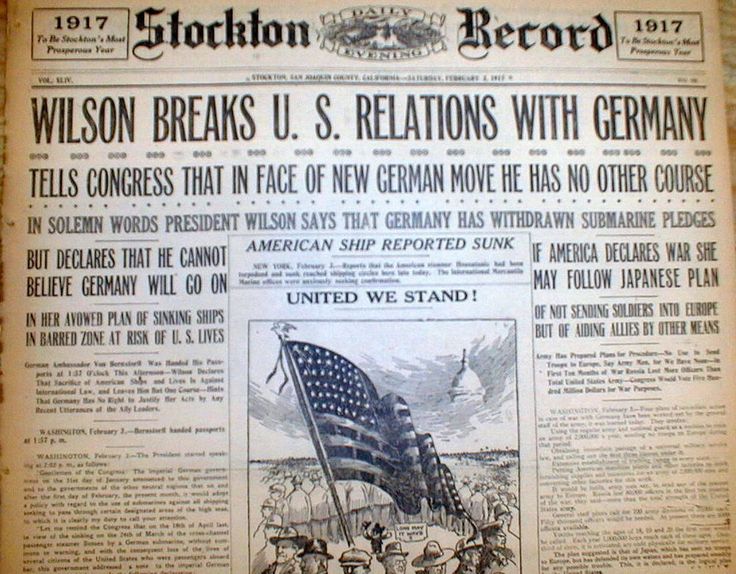
BEGINNING WITH THE FEB. 14, 1917 issue, THE FATHERLAND became THE NEW WORLD, saying they were making the change "to avoid misunderstanding and unnecessary provocation." On February 3rd, President Wilson had declared to Congress that the U.S. had broken off diplomatic relations with Germany because of its announced change in submarine warfare policy. Ambassador Bernstorff was given his passports by the State Dept. and sent back home to Germany. Everyone knew this brought us that much closer to a declaration of war.
This first issue of The New World featured an "Address to the American People" by the peace-maker William Jennings Bryan, who resigned as Wilson's Secretary of State in June 1915 in protest to Wilson's refusal to warn Americans not to travel on British ships carrying contraband. I have published that address further below because I want to start with Frederic F. Schaefer's inside look at the political reactions in Washington, D.C. -cy
vol. 6 no. 2 Feb. 14, 1917 Page 8
Behind the Scenes at the Capital
(Special Correspondence of THE NEW WORLD)
WASHINGTON, D. C., February 6—Although signs of an impending crisis over the German note were not wanting, nobody on Friday (Feb. 2) believed in the possibility of a rupture of relations with Germany, and with that peculiar desire to explain away, on rational grounds, what seemed to be facts pointing to obvious conclusions, which is part of the temperament of the parliamentary lobbies in times of stirring developments, a remarkable feeling of optimism prevailed, and the possibility of war seemed extremely remote.
President Wilson has a way of keeping his own counsel. Retired within his privacy and debating the impending problems with himself, consulting only with Col. E. M. House and latterly, after mature reflection, with Secretary Lansing, the public on Saturday morning was little prepared for the startling news that began in whispers to circulate through the corridors of the Capitol and to penetrate the offices of Senators and Representatives a little after ten o'clock:
“Bernstorff has been given his passports and Gerard has been recalled from Berlin!”
* * * *
The President was to address the joint Houses of Congress in special session at two o'clock. The long friendship between the United States, the second home of the German race, and the country of Frederick the Great, who had said in reply to England's offer of alliance, “If England would give me all the millions possible, I would not furnish it two small files of my troops to fight against the colonies,” was suddenly about to be shattered like a dream.
To many Representatives outside of New England and the South, of sections where there is the strongest possible amalgamation and blending of the races, and where the traditions of the pioneer period and the Civil War have kept alive memories of the patriotism of the Germans in America and of the financial support given the Union by Germany in its darkest hours, when England and France were equipping warships to prey upon our commerce and seeking our destruction—when France was already building an incipient monarchy upon our borders in defiance of the Monroe Doctrine and extending her hand to seize the Gulf of Mexico—the announcement came with sickening emphasis. It was felt that a severance of diplomatic relations would be followed by war, and that the century-long amity would soon be succeeded by operations in which brothers would shed the blood of brothers and cousins of cousins.
As from the awakening after a dull blow came the consciousness that the great peace movement that promised so much a week before had come to naught; that the efforts to keep the country out of the European maelstrom of blood had been vain; that the result of the late election with its pronouncement against war, had been nullified overnight by the decision of those in power in Berlin and Washington.
Members of the House Foreign Committee were hurriedly called to their committee rooms, wondering what had happened. There had been a consultation between the President and prominent members of the Senate the night before. But the secret had been well guarded, and it did not become known till later that the debate on the steps to be taken in view of the German note announcing that the German Government was about to avail itself of the reservation contained in its note of May 4, 1916, had developed a decided conflict of opinion, but that a strong majority had favored the President's course to hand the German Ambassador his passports and recall Ambassador Gerard. This reservation is in the following words:
“It (The German Government) does not doubt that the Government of the United States will now demand and insist that the British Government shall forthwith observe the rules of international law, universally recognized before the war, as laid down in the notes presented by the government of the United States to the British Government December 28, 1914, and November 4, 1915. Should steps taken by the government of the United States not attain the object it desires—to have the laws of humanity followed by all belligerent nations—the German Government would then be facing a new situation in which it must reserve to itself complete liberty of decision.”
The U-boat campaign, so long held in abeyance, was about to begin, and our Government felt it had no alternative but to act upon its ultimatum that such a course meant severance of relations.
Yet even then the temper in Congressional circles was singularly placid. The feeling of light optimism had vanished; it was generally recognized that the situation was serious; but though the news had circulated for four hours, there was no jam in the corridors, and the House galleries filled slowly with the families of members and their friends anxious to hear the President utter the momentous words that were to decide the question of war or peace.
The President spoke in his usual clearness of tone, with great earnestness, and the crowded hall and the well-filled galleries listened with intense closeness of attention. Universal applause greeted the closing of his remarks, and as he passed down the east side through the lane made for him in the crowd on the lower floor to go to his car, closely guarded by Secret Service agents, shouts and applause went up at his appearance.
The great scene was over in little more than half an hour. The President was speeding down Pennsylvania Avenue on his way to the White House; the guards in the corridors were withdrawn, the usual passage ways thrown open again to the public, and legislative proceedings resumed their normal course at both ends of the Capitol. In twenty minutes everything was moving along as though nothing out of the usual order of things had transpired. The United States of America had broken with its traditional friend of more than a century, and only the partisans of Great Britain were rejoicing.
The mob spirit had not shown any signs, but in the afternoon and evening veiled threats were heard in several German cafes that these places would soon be closed, and Saturday afternoon many Germans applied for their first citizenship papers.
There could be no doubt that Washington was firmly behind the President, but there was not even then any enthusiasm for war. Members showed in their manner that they were stunned. They said the country did not want war, but now that the die had been cast there was no retreat, and right or wrong, the country's honor must be maintained. “When we get this matter settled,” exclaimed one, “it will be up to us to settle the question whether we are a dependency of Great Britain or a self-governing people,” but nowhere could be heard an expression of criticism on President Wilson's action. Even yet members ventured to express the belief that actual hostilities could be averted, and that the Chief Executive would do his utmost to avoid the ultimate step. It seemed too appalling, this thing of plunging into the maniacal debauch of blood which is drenching the European continent.
* * * *
The influence for peace which the 21,600,000 white Americans of German descent might have exercised in conjunction with the great army of pacifists of other blood, headed by Hon. William Jennings Bryan, has not availed against the current of events. A certain percentage believed in the justice of the Allied cause from the beginning and made its influence felt on that side, just as there were men of other strains who announced their belief in the justice of the Central Powers. These divisions no longer can be emphasized.
The saddest share of the tragedy falls upon those who have brothers and cousins in the countries of the Central Powers. There are a million such cases. There are thousands of Germans, Austrians and Hungarians who are not citizens, but who came here trusting to our hospitality and were caught by the unexpected outbreak of the war, unable to return to their homes. Against them an undercurrent of wrath will undoubtedly be directed.
Will the United States, the great melting pot of nations, the refuge of the oppressed, the home of the free, model its course upon the ruthless policy of the Allies toward their internees and expose them like lepers to the violence of hate and persecution?
There is no such feeling in Washington. If it comes to the worst, and blows are struck, Uncle Sam will adhere to his ideals, it is believed, and not give the lie to the traditions and doctrines of 130 years. Those responsible for outrages against the defenseless will be summarily punished, and the lot of the unfortunates will be made as bearable as the dictates of humanity and Christian charity prescribe.
Some firebrands are already talking of a German revolution in America and trying to inflame public sentiment against German citizens. I talked with half-a dozen member of Congress from districts thickly populated with this element. They indignantly spurned the suggestion as only calculated to incite additional hatred against the most law-abiding people in the country. The German element, they said, is opposed to the war because it believes that but for Russia and England there would have been no world-wide conflagration. Many of them say that but for the money loaned and the supplies of munitions shipped to the Allies the war would have been over; but they are American citizens and not aliens. Their wives and children were born here and the majority are intermarried with British and other racial elements, and whenever their sympathies may lie, their homes, their material interests, are American. If there are riots and blood is shed in local clashes, it will be due to uncalled-for provocations by those in every community who love trouble for trouble's sake, and not to disloyalty on the part of any considerable number of citizens, however deeply they regret the abandonment of our neutrality. -F. F. S.
WALL STREET HAS A HOLIDAY
“WALL STREET,” we read in the headlines, “Goes Wild Over News. At Flash from Washington, Flag Rises on Exchange and Brokers on the Floor Sing Star Spangled Banner.” Stocks advance from four to thirty-five points in the wildest tumult that has been witnessed in the market when the severance of diplomatic relations with Germany was announced. The rise in American Can was startling. When the news of the break first reached Wall Street it was selling at 36 ½. Within a few minutes it has risen to 41 and it closed at 43. The greatest jump, however, was that of Bethlehem Steel, which on a few transactions rose from 363 to 400. Teas Company made a net gain of 10 points, Industrial Alcohol 9 ¾ points, American Locomotive 4 7/8, American Beet sugar 3 ¾ points, New York Air Brake 5 points and New York Central 2 ½ points. At the same time the Anglo French bonds dropped to 91 ¼.
Mr. Morgan is said to have had a hand in the exhilaration of the war brides. Our old friend Henry Clews made an enthusiastic speech. Joseph H. Choate, former Ambassador to the Court of St. James, and director of the Morgan-controlled “German American Insurance Company,” exclaimed with a dry chuckle: “I am glad of it. It ought to have been done long ago.” Can there be anything more fiendish than the picture of a decrepit old man on the brink of the grave, rubbing his palsied hands with delight and satisfaction at the thought that thousands of young men may have to go to their death?
Wall Street wanted a rupture with Germany. Wall Street wants to regild its investments in Allied war loans with the blood of the American people. Now that we are on the brink of war, Wall Street has its holiday. The entire hidden machinery of this hideous war propaganda, the secret alliance between money-mad Americans and unscrupulous British politicians, is revealed in Charles A. Collman's “The War Plotter of Wall Street.” If you want to understand the unholy joy of the munition makers and war gamblers, read Mr. Collman's book. (This book may be obtained through THE NEW WORLD for 25 cents.)
Very wise words from Mr. Bryan …..
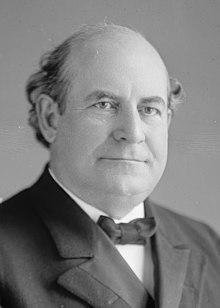 ADDRESS TO THE AMERICAN PEOPLE
by William Jennings Bryan
IN the presence of threatening dangers whose magnitude cannot be overestimated, I venture to address my countrymen, justifying my appeal to my interest in their welfare and by their acquaintance with me.
The President has felt it his duty to break off diplomatic relations with Germany for reasons stated in his message and has announced to Congress his purpose, in case of any overt act, to ask authority to use any means necessary to protect our seamen and people.
We are thus face to face with a grave possibility of being drawn into the European war. The President, Senators and Congressmen who must act for the people in this crisis desire to carry out the will of their constituents, but unless the rank and file of the people make known their wishes by direct communications, these officials must judge public opinion by the expressions of the metropolitan press, which may or may not correctly reflect the sentiments of the Nation.
Our Injuries Incidental
To decide whether war is necessary or not we must consider the situation. The belligerent nations on both sides think themselves in a death struggle, and both sides feel justified in resorting to acts which we regard as contrary to international law as heretofore interpreted.
While we dispute their right to conduct the war as they have, and honestly protest against the violation of our rights and the sacrifice of our interests, we must not forget that the injuries which we suffer from both sides are incidental to their effort to injure each other and are in no case intended against us. We can better afford, therefore, to be patient and forbearing than we could if injuries came from avowed enemies and were intended.
The President, in his noble appeal to the belligerents, has asked that they forget the bitterness engendered by the killing of more than six millions of human beings and the expenditure of more than fifty billions in money and come together in an honorable peace. If we can expect such an exhibition of virtue by them are we not in duty bound to measure up to the standard which we have set for them. There are several alternatives from which to choose.
Choices of Action
First, we can postpone until the war is over the settlement of any dispute which cannot now be settled by peaceful means.
Second, we can keep American citizens off belligerent ships.
Third, we can refuse clearance to ships of the United States and other neutral countries carrying contraband and passengers on the same ship.
Fourth, we can withdraw protection from American citizens who are willing to jeopardize gthe Nation's peace by traveling as seamen with contraband on American or neutral vessels.
Fifth, we can, if necessary, keep all American vessels out of the danger zone for the present, just as the Mayor of a city keeps citizens in their homes when a mob is in possession of the streets.
Sixth, Congress, which has exclusive power to declare war, can submit the declaration to a referendum vote making exception in case of actual invasion.
We cannot depend upon precedent to meet an unprecedented situation. Other alternatives are likely to be suggested.
Let the People Be Heard
The most important thing is that the officials at Washington shall know that the people at home protest against entering this war on either side, with its frightful expenditure of blood and treasure; that they are not willing to send American soldiers across the Atlantic to march under the banner of any European monarch or die on European soil in settlement of European quarrels, and that they are not willing to surrender the opportunity to render a supreme service to the world as a friend to all and peacemaker when peace is possible.
Wire immediately to the President, your Senators and your Congressmen. A few cents now may save many dollars in taxation and possibly a son.
Washington, D.C., February 3, 1917
____________________________
The next, and last, installment in this Fatherland series will be another article by the “Naval Expert” on the planned German Blockade of the Entente Countries.
The Villanova digital library only contains the issues under The Fatherland title. George Sylvester Viereck continued to publish as The New World and The American Weekly until August 1918; as Viereck's American Monthly until Oct. 1920; and continued publishing until 1927.
- 647 views