



From the Handbook for Schooling the Hitler Youth
Chapter Twelve: The Soil as a Source of Food Supply (Handbook online is here)
The first necessity of all living things is food. From man's first day he must be fed by the gifts of earth, fruits of the field, and the flesh of animals. Vegetation and animal life are in turn dependent upon the nature of the soil and climate. The soil, which supplies food for a people, has therefore the greatest economic significance for men.
The quality of the soil in the German Reich is not equally good everywhere. A large part of the German Reich is covered with sandy, marshy and rocky soil. The main part of this rather unfruitful soil comprises the non-arable mountain ranges and the north German plains once covered with ice. Only a proportionately small region has very good soil. It is distributed in the main along the lower courses of the German rivers (Rhine, Oder, Vistula), in south Westphalia, along the borders of Hanover, around the bays and inlets of Saxony, the Rhine basin, in Württemberg, lower Bavaria, and the Rhine-Main region, as well as the southern parts of Thüringia and middle Silesia.
Nor is the climate equally good everywhere in the German Reich. The mildest weather prevails along the Rhine, since warm air currents from the Mediterranean penetrate Germany through the doorway between the Alps and the Vosges Mountains. Along the coast a moderate, seasonable climate prevails because the sea brings about a balance of temperature and humidity. The farther the land is from the coast, the more extreme the climate. Hot summers and cold winters in the eastern sections allow only a comparatively short growing period. By reason of these influences of soil and climate the productiveness of the different farming areas in Germany varies greatly.
The German territory belongs within the great forest zone which stretches over the north of Europe, Asia and North America. Originally Germany was covered by a more or less dense forest. But now the encroachment of man has pressed the woodlands back to their present confines and opened up soil for cultivation.
From time immemorial men have not only gathered the products of the German soil but have regularly farmed it. The Norsemen of the early stone age cultivated twelve different kinds of grain. They raised fruit, flax, and many kinds of vegetables. With the exception of poultry they had all our domestic animals. The Germans went on to develop husbandry and cattle raising. They were a settled peasant folk who worked the soil without stint. When they came into contact with the Romans, their agrarian culture was already so high that the southern people took over from them, among other things, the wheel plough and the cultivation of rye. It was not the Romans nor even the monks who introduced farming into Germany. During the middle ages in Germany the transformation of the original soil into land for agricultural purposes began on an even larger scale. Forests were cleared, moors and marshes drained, and dams built to prevent the overflow of sea and river. This work has been continued down through the centuries. It is only necessary to recall the work of cultivation of Frederick the Great in Orderbruch and his homesteading activities in the rest of the German east. This work, even today, has not yet come to a halt. The Labour Service continues to win and make land for the German farmers. By persistent work the original land of nature became that kind of cultivated farm land which gives the central European space its marked German imprint.
The quality and limitations of the German land
Since 1919 the political territory of the German Reich has extended over an area of 472,000 square kilometers. More than a fourth is covered with forests; about 5 per cent is taken for dwelling purposes, streets, railroads and parks; 2 per cent is covered with water. Four per cent is wilderness. The remaining two-thirds (around 312,000 sq kilometers) is left for agriculture. The soil is used in the following ways:
-Farming includes an area as large as the provinces of Rhineland, Hesse-Nassau, Saxony, Brandenburg together with Grensmark, Silesia, East Prussia and Mecklenburg.
-Meadows and pasture lands are as great as the area of Hanover, Schleswig-Holdtein and Pomerania.
-German forests extend over an area as large as all of Wüttemberg, Baden and Bavaria
-The amount of wasteland is as large as a whole province the size of Westphalia.
In farming a variety of plants are cultivated, each according to the climatic conditions and the productiveness of the soil in the individual districts.
-Rye thrives best on the barren, sandy soil of North Germany and in the cool, mountain regions. -Wheat prefers the better soil of the hilly slopes in central Germany, the heavy, marshy soil along the Elbe and Vistula, and the loose soil of Silesia.
-Oats are better adapted to the niggardly soil of north-western Germany.
-Sugar beets are raised principally on the nutritive soil in Silesia and in the foothills of the mountains in central Germany.
-The potato has spread out over all Germany, but is raised especially in the central and eastern parts of the north German lowlands and on the mountains along the Rhine.
-Fodder in large amounts exists only in East Prussia, Saxony, Thüringia, Holstein and the Rhine valley.
-Truck farming is carried on principally in the vicinity of large cities. In addition there are rather large areas devoted to truck farming in Saxony, Thüringia, Holstein and the Rhine valley.
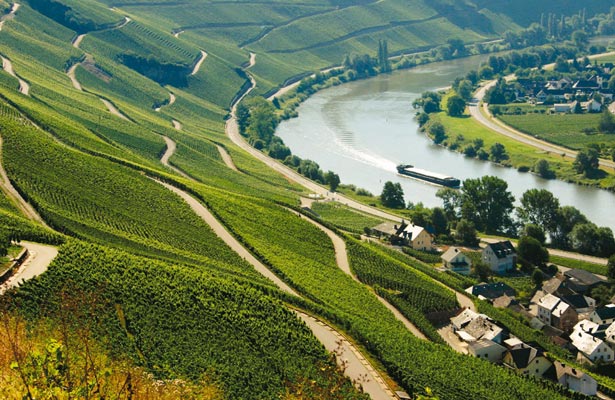
-The only vineyards today are along the Rhine and its tributaries (Mosel, Saar, Nahe, Neckar and Main), comprising nearly 10 per cent of the agricultural area. In this region a great deal of fine fruit is also cultivated.
Animal husbandry provides the German people with meat, fats, dairy products and eggs. Cattle raising is carried on primarily in regions along the northern coast of Germany, in the Alps and its foothills, while horse breeding takes place in East Prussia, Hanover, Bavaria and Brandenburg. Hog and sheep raising go on mainly in northern and central Germany. The principal regions of poultry farming are Pomerania and central Germany. [See map in online book here]
The German Reich is the most important producer of oats in Europe. It also produces a fourth of the world's rye. In spite of the increased consumption of sugar since the War, German sugar production is still greater than the domestic needs. Rye, oats, and sugar beets were formerly exported therefore. All remaining agricultural products cover, however, only a part of Germany's requirements. The German Reich could assure the feeding of its population only by means of imports.
During the preceding century as well as during the last decades those in responsible positions have faced this fact without concern. They have neglected German agriculture because of cheaper foreign prices. And so the basis for feeding our thickly populated Reich was destroyed. The experiences of the World War have taught us, in this regard, that the basis for feeding the German people must not be looked for abroad. For as sacrifices to the enemy blockade 88,000 undernourished women, children and old men died in 1915; 122,000 in 1916; 260,000 in 1917; and 294,000 in 1918. We will always experience this fate if we have not assured the feeding of our own people within our own territory.
The dictate of Versailles, by separating and taking away large surplus agricultural regions in West Prussia, Posen, North Schleswig and in Alsace, and by robbing German colonies, made the basis for feeding our people far worse. With the loss of the colonies, the Reich lost every chance for producing colonial products herself, such as cocoa, tea, coffee, bananas and tropical plants (coconuts and citrus fruits) and was made completely dependent upon imports so far as these are concerned.
In the regions taken away along the frontiers, the Reich lost, along with one eighth of its territory, a yearly production of
- 5,000,000 tons of grain
- 11,000,000 tons of potatoes
- 3,200,000 hogs
- 2,600,000 head of cattle
- 790,000 horses
- 535,000 sheep
In 1914, the German colonies had the following areas devoted to plant husbandry:
- 42,000 hectares of cocoa palms
- 5000 hectares of oil palms
- 13,200 hectares of cocoa
- 4800 hectares of coffee
- 2200 hectares of bananas
Rescuing German farmers from impending ruin
National Socialism has not remained inactive in the face of the present condition of our food supply. It has learned the lessons taught by the World War, and has done everything to assure the feeding of our people from its own soil. To this end agriculture had to be rescued from impending ruin first of all. Protection against foreclosures, reduction of the debt burden, and lowering of interest rates served this purpose. Then, by the National Inheritance law of September 29, 1933, farmers were relieved of the burdens of the capitalistic land law which treated land as an article of trade. From now on peasant estates are fundamentally non-saleable, non-distrainable, and indivisible. Any further pernicious breaking up of peasant holdings is thereby checked. The Reich Food Estate Law of September 13, 1933, supplied the legal basis for organising the agricultural estate itself. The farming population, broken up into many hundreds of organisations, associations and groups, was brought together into one great front and transformed into a mobilised instrument of National Socialist agrarian policy. By the same law a comprehensive system for regulating markets was also set up which assured the sale of agricultural products and provided an economically just price for them. And so the most important requisites for the work of reconstruction in the sphere of feeding a population were created. The Reich Peasant Leader could now issue the call for the battle of production which he did at the second Reich Peasant Day in Goslar in 1934. This battle should guarantee for us, in addition to the military independence which we have again won, an independence so far as food supplies are concerned, and free us so far as possible from the necessity of importing foodstuffs from abroad. Since it is actually impossible to reduce the consumption of foodstuffs, everything hinges on our ability to increase our domestic production of food supplies to equal the need.
The best methods of doing so are:
- first, enlarging agriculturally usable areas;
- second, increasing the productivity of existing farms;
- third, reducing waste and destruction of agricultural products;
- and finally, cultivating needed products which have up to this time not been produced at all, or not in sufficient quantities.
The extension of agriculturally usable areas is being realised by cultivation and land reclamation. From 1933 to 1936 the Office of Land Cultivation cultivated an area of 1,500,000,000 hectares with the help of official subventions and credits. One assumes an average increase in yield of 20 per cent, so this signifies a winning of 300,000 hectares of new land, whereas from 1929 to 1932, using the same method of reckoning, only a winning of 85,000 hectares of new land resulted. The accomplishments in the field of land cultivation, however, evidence only a beginning. During succeeding years the work will be continued and should, as the following presentation shows, make possible the recovery of about 6,500,000 hectares. [see chart on page 91 in online book here]
Increasing domestic production
The principal agency for carrying out the work of land rehabilitation is the National Labour Service. Besides numerous smaller reclamation undertakings, it is for the time being at work on 30 large projects, which alone comprise an area of 600,000 hectares. [see map at top of page 92 in online book here]
To increase the yield of existing farm lands, it is first of all necessary to strengthen the working forces on the land. On newly reclaimed land, as well as on other land which is not being profitably tilled, homesteaders and farmers are being established for this purpose. And here, too, National Socialism has done far more than the previous system, as we perceive from the following presentation: [see charts on page 92-93 and 94-95 here]
This presentation shows that we are still dependent upon imports for some important foodstuffs. Within the scope of the Four Year Plan efforts to increase still further the domestic production will be extended. The most important measures are:
- strengthening of land reclamation within the program of land cultivation,
- reduction in the price of fertilizer,
- speeding up the unification of diversified land-holdings,
- government aid for building manure tanks and sunken pits,
- raising the prices for rye and early potatoes,
- reducing the prices for seed potatoes through government aid,
- government aid for breaking up meadows and fencing in meadows and pastures,
- short term credits for construction purposes,
- government aid for building dwellings for land workers,
- building up of economic advisory services.
These government subventions obligate the German farmers, but not less so the German consumer. For the greatest efforts can only be fruitful naturally if they are supported by German comrades in every possible way. It is the public duty of every German, for the sake of attaining the goal which is being striven for, namely self-sufficiency in food, to cooperate by adapting his needs to those products over which Germany exercises control in fullest measure: [see lists on page 96 in online book here].~
- 1015 views
Comments (7)
AfD calls for an about-face in agriculture
carolyn
Stephan Protschka, member of the federal executive board and agricultural policy spokesman for the AfD in the Bundestag, says on World Food Day:
"The abundance of food products in our supermarkets deceives us about a serious problem in our society. A large part of our population lives off the cheapest mass goods, which we cannot recommend in the long run. Sustainably valuable food produced from a wide range of regional quality products is increasingly becoming the privilege of a dwindling middle class. This vicious circle must be broken.
"The number of pensioners and children affected by poverty is rising alarmingly. According to a Bertelsmann study, over 21 percent of all pensioners will be affected in 20 years' time. The situation for children in Germany is already much more dramatic. For around 31 percent of all children, the families' money is not enough to provide them with a varied and balanced diet. For two thirds of them, this condition lasts for several years.
"The AfD is therefore calling for a correction in an agricultural policy that has for decades not prevented the death of family farms lost to mass producing large farms. As a result, the overcrowded food shelves of many supermarkets offer masses of cheap products, while high-quality, healthy and organically produced food comes at high prices. This is where the AfD wants to start, because above all the medium-sized family businesses produce more sustainably and regionally --the regional processing of the products and the solidarity with their soils and animals are the basis for this. Scandals such as the recent Wilke sausage products or eggs from the Netherlands show the superiority of family-run businesses. This ensures a better quality of life through healthier food for all strata of our population," says Protschka.
The Aryan youth primer :
Trevor Field
Hi Carolyn, I am pretty sure the original title of this handbook may have been - The Aryan Youth Primer - Official handbook for the schooling of the Hitler youth. Somehow that Jewish Marxist slur 'nazi' has made its way to the front cover and in translation, it has deliberately been titled The 'NAZI' Primer.
Not Aryan, but strictly Hitler Youth
carolyn
Hi Trevor,
Glad you brought this up. I don't think it would be "Aryan Youth" but Hitler Youth. It may have been "The National Socialist Primer" or even something other than "Primer." We don't see a copyright date, do we? So perhaps someone put this out after 1945 and renamed it "Nazi Primer." In the first intro in the book, which doesn't appear in my print-out, the last line reads:
"To foster the building up for a political will in the Hitler Youth organization, according to the National Socialist outlook on life is the task of this little handbook for the schooling of the Hitler Youth."
Nowhere in the book does it ever use the word Nazi. Interestingly, the first part of that paragraph is as follows: "For the National Socialist outlook on life is not something ingeniously devised. It is no theory, but adapts itself strictly to existing reality. The ideal of National Socialism is born of experience. It is a factual and realistic outlook on life. The most significant and most efficacious realities in the life of a people are 'Blood and Soil.' Whoever recognizes their binding force and effects in history can also take part in shaping the future."
The Publisher
Trevor Field
Hi Carolyn, all I can find are multiple authors including, a Fritz Brennecke and a Dr Harwood L Childs who apparently was the translator. Printed/ Published in 1938 by Harper Brothers London and New York. As you stated nowhere in the book does the slur 'Nazi' appear. However, the book description is a giveaway as it talks about Fascism (which as you know is not National Socialism) 'distorted' science and 'Nazi' propaganda designed to indoctrinate the Hitler Youth. The more they put him down the more I admire this man.
Randall Bytwerk has a portion
carolyn
Randall Bytwerk has a portion of it translated on his site https://research.calvin.edu/german-propaganda-archive/hjhandbuch.htm and he gives this information:
Background: This material comes from a booklet of material for Hitler Youth leaders. I translate the sections dealing specifically with race, though to the Nazi mind race and soil (Blut und Boden) were inextricably related. This material provided leaders with the background they needed to convey Nazi racial thinking to young boys.
The source: Fritz Bennecke (ed.), Vom deutschen Volk und seinem Lebensraum. Handbuch für die Schulung in der HJ (Munich: Franz Eher, 1937). Paul Gierlichs is listed is listed as Bearbeiter.
Bennecke is editor, along with Gierlichs. No author name. This was translated to be printed and sold in England. According to Bytwerk, who is pretty reliable, the original title was "The German people and their habitat. Manual for the training in the HJ" [Vom deutschen Volk und seinem Lebensraum. Handbuch für die Schulung in der HJ]. Some joker decided to shorten it to "Nazi Primer."
In many places it's said the author is Adolf Hitler. I knew that wasn't right, not directly anyway.
Thanks for inspiring me to look into this. I didn't know to begin with there was so much online about it.
Great work Carolyn!
Trevor Field
Good stuff Carolyn, we both have learned from this dialogue! And again it seems a Jewish hand or allies ( all lies ) indoctrinated propaganda campaign to twist the truth is and was in existence from 1937 (re this handbook). Every time I see the slur 'Nazi' a red flag appears in my mind. It is such a difficult task to penetrate the brainwashing about Hitler as it is ongoing daily in social media and MSM. Keep up the good work and if you get a chance I would love you to revisit a hero of mine in Michael Collins Piper and his great work. I have hundreds of his archived shows and shortly before his tragic death, he mentions that he was planning a book on Hitler. That would have been a hellluva great book!
Bytwerk
Janus
Bytwerk is fairly reliable, but I did catch one possible (and likely deliberate) mistake in his translation of "Nazi-Sozi" (which could have met the same fate as the "Nazi Primer"). Bytwerk renders it as "decent" Jews and "decent" Christians. Pretty sure weiße and gelbe refer to color. The second link has the better translation.
https://research.calvin.edu/german-propaganda-archive/nazi-sozi.htm
https://archive.org/details/TheNaziSoziQuestionsAndAnswersForNationalSo…