



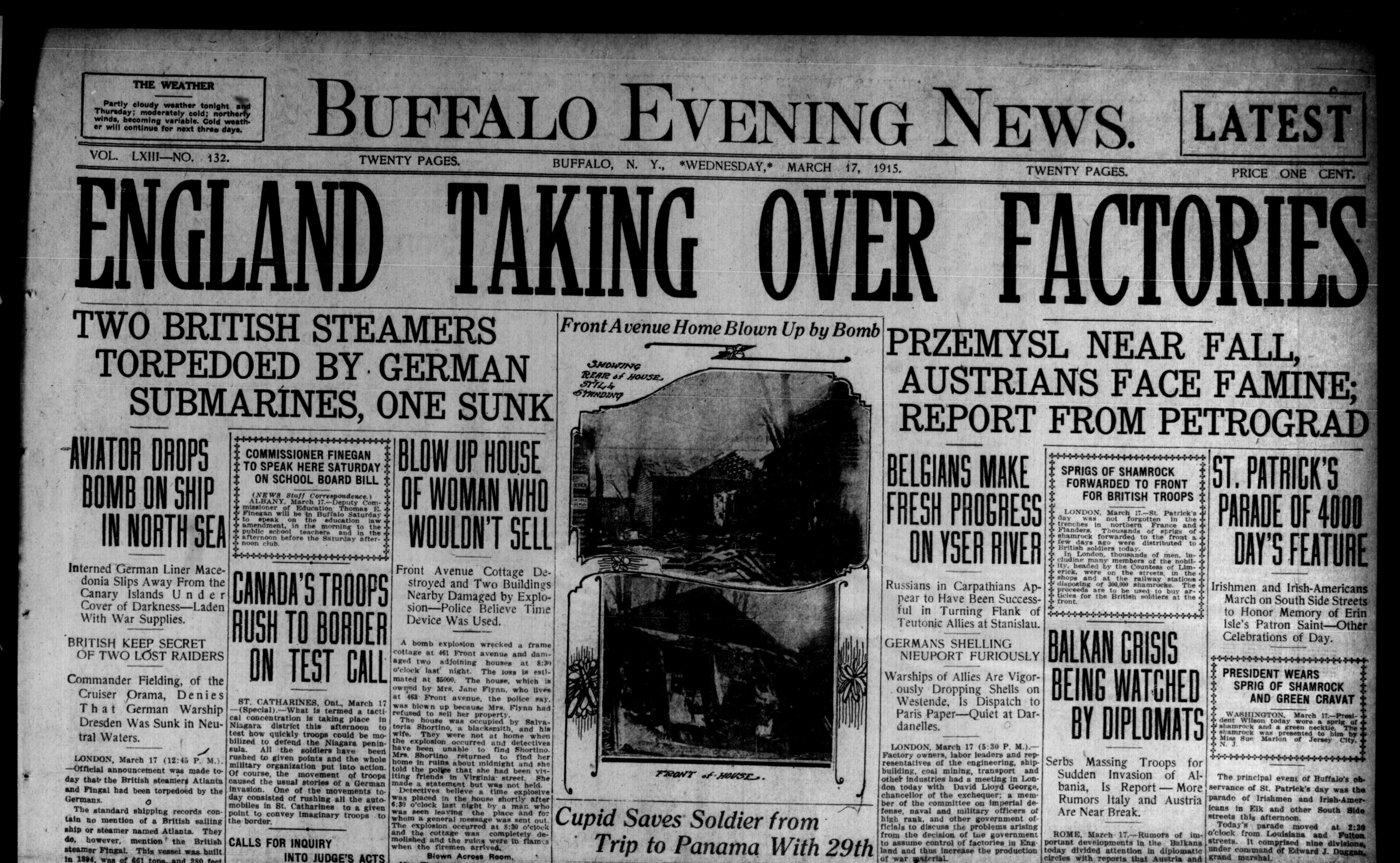
More from THE FATHERLAND in the spring of 1915 by the most excellent writers Frederick Schrader, Houston Stewart Chamberlain and Dr. Edmund von Mach. The amount of munitions delivered to England from American factories is receiving more and more criticism, along with the obvious favoritism for England from the self-proclaimed “neutral” United States and it's biggest newspapers. This post contains five articles in all.
ARE WE ENGLAND'S SECRET ALLY?
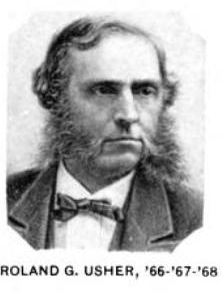 Prof. Roland G. Usher Declares the US is in a Coalition to Help England, France and Russia in Return for Concessions—Alliance Aimed to Crush Germany-Austria
By Frederick F. Schrader
IS there a secret alliance between the United States and England? The question may startle those who have not given the subject of our present relation with the world powers and our statecraft, within the past twenty years, more than perfunctory consideration. It is undeniable that with the Spanish War [1898] the American Government turned into new channels of diplomacy and established new relations with England. Many things have occurred since then which the average American cannot easily explain to himself.
During the Boer War [1899-1902] we were, officially, on the side of Great Britain. No European monarchy contributed so freely in official sentiment and substantial material to the defeat of the Boers as we. English officers appeared everywhere in this country to establish camps for the inspection of mules and horses. There were such camps at Kansas City and New Orleans. We supplied arms and ammunitions to the English. Every port contained English transports and vessels loaded with supplies for the British army in South Africa. The same outcry of the American element, which is against such shipments, went up then as now. General Pearson, acting for the Boers in this country, declared that if the United States would stop the shipment of mules and guns to the English, the Boer republics were sure of victory. Mass meetings were held and protests launched against the unholy traffic in the means to destroy two flourishing republics; but no attention was paid to these things, while the protestants in Congress, such as Senator Hale, were told to hush up. The same old argument was used: “The Boers have the same right as the English to buy what they want in our markets. We are strictly neutral.”
But were we strictly neutral? Mr. Joseph Chamberlain, then the English Colonial Secretary, let the cat out of the bag in a speech in the House of Commons. He spoke of “an agreement, an understanding, a compact, if you please,” between his government and the United States. The subservient American press that was in a position to inquire seriously into this “agreement, this understanding, if you please,” sealed up all sources of information, and only a few independent papers, notably the Washington Post, commented freely on the admission of Joe Chamberlain and clearly judged the policy of the administration in the light of this important slip of Chamberlain's tongue. Editorial after editorial was written by the late Richard Weightman on the importance of an explanation. But the State Department observed discreet silence.
That this is no idle speculation; that others are convinced that the pitiable surrender of American interest to English dictation in all questions affecting our permanent prosperity, our rights as a neutral nation to transact business with non-combatant communities and to foster our trade in non-contraband goods in peace under rules established by long practice and written guarantees, that the dual policy of the administration in dealing with Mexico on the one hand and with Germany and Austria-Hungary on the other, and the arbitrary enforcements of rules against German wireless stations and German ships, which are ignored toward English cables and vessels, constitute a policy that rests upon a secret “agreement, or understanding, a compact,” between Washington and London, is publicly confirmed by Roland G. Usher, Professor of History at Washington University, whose works, “The Rise of the American People” and “Pan-Germanism,” are generally accepted as books of authoritative origin.
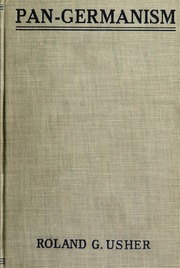 Mr. Usher declares outright that there is a secret understanding between the Allies and the United States, and in “Pan-Germanism” he calls attention to specific instances in which the policy of the United States has been distinctly influenced and directed by this alliance against Germany:
First, that in 1897 there was a secret understanding between this country, England, France , and Russia, that in case of war brought on by Germany the United States would do its best to assist its three allies. Second, page 151, that “certain events lead to the probability that the Spanish-American war was created in order to permit the United States to take possession of Spain's colonial possessions.” Third, that England possesses three immensely powerful allies—France, Russia, and the United States. These he constantly speaks of as the “Coalition.” Fourth, that the United States was not permitted by England and France to build the Panama Canal until they were persuaded of the dangers of Pan-Germanism.
That these are not the idle statements of a sensational pamphleteer is vouched for by the character of the author and the high standing he enjoys as an American historian. “Pan-Germanism” was published in 1913, and these statements have never been disputed.
If we view the policy of this administration in the light of Mr. Usher's assertions, it becomes clear why we are not neutral and why the State Department is forced to employ every available subterfuge to calm the insistent demands of the English organs and public men, as well as the clamor of Prof. Chas. W. Eliot, Theodore Roosevelt, and others, for active intercession of the United States in the European war on the side of the Allies.
We are pledged to assist the Allies, but for the present the government is in the hands of a conservative President, and our aid is extended only in the shape of guns, cartridges, shells, dum-dum bullets (yes we manufactured these specifically at the request of the English -cy), powder, horses and mules, together with all the accessories and trappings belonging thereto.
Without knowing it, those of us who are in active sympathy with the German and Austro-Hungarian cause may have good reason to thank Providence that Theodore Roosevelt is not now the tenant of the White House in Washington. The rough rider's remarkable change of attitude toward Germany, an attitude popularly supposed to be one of sincere appreciation of German culture and friendship for the German Emperor, to one of pronounced antagonism, marked by clamorous appeals to the passion of the American people over the violation of Belgian neutrality, is clearly explained by the light of these revelations, for, of course, as ex-President he must know of the coalition against Germany, and he must have admitted (Harvard President) Prof. Eliot and ex-Ambassador Bacon into his confidence. Prof. Usher was formerly assistant professor of history at Harvard, and there we have the connection one with the other.
This, too, may explain the passage in [Sec. of State] Bryan's letter to (Ambassador to US) Count Bernstorff of April 22: “That the relations of the two Governments with one another cannot wisely be made a subject of discussion with a third Government, which cannot be fully informed as to the facts, and which cannot be fully cognizant of the reasons for the course pursued.”
Yet how long will it be until this country is asked to send its sons to shed their blood on the battlefields of France and Belgium for the coalition? Who will say what day and what hour will see us sending our ships to the North Sea or the English Channel, to do what the English navy has refused to do? To expose our ships to submarine attacks in order to enable England still to rule the waves and Russia to become the dominating power of Europe?
It was just this kind of secret “agreement, this understanding, if you please,” between Sir Edward Grey and Delcassé which precipitated the English and the French people into a war which neither would have risked from free choice.
Are the American people being betrayed? Are they to be delivered hand and foot, boots and saddle, into the hands of England and Russia? Is Wilson standing in the way of carrying out the policy inherited from John Hay? Is he seeking to placate John Bull by sending him munitions of war and keeping good the credit of the Allies with J.P. Morgan? Or are we on the eve of entering the war in response to the clamor of Prof. Eliot, Col. Roosevelt, Mr. Bacon, the rest?
Will the American people demand the truth, or will they submit supinely like a subject-people to rulers who form alliances without their consent?
v. 2 no.10 April 14, 1915 Page 9
ENGLISH AGENTS AND AMERICAN PAPERS
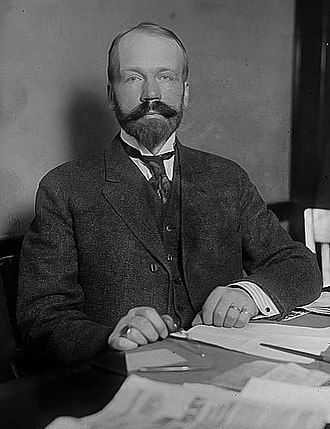 By Dr. Edmund von Mach (pictured right in 1915, author of “What Germany Wants”)
MR. FORBES SUTHERLAND, who is in the employ of the British Government and also of the Boston Herald, in an unguarded moment made the statement printed below. He was addressing the Boston Press Club on January 14, 1915, and like so many Englishmen and English-Americans believed that this country was solidly British, because its big Eastern press is so. Assuming, therefore, that he could drop the British mark of piety and discuss one phase of the pre-war history in which he himself had been a prominent factor, he said, in substance, the following:
That for several years he had been a member of the British Military Intelligence Department—
That he landed in New York toward the end of June [1914] and he there found a cablegram from the home office in London, already three days old, telling him to report immediately—
That he landed in New York toward the end of June and he there found a cablegram from the home office in London, already three days old, telling him to report immediately—
That he telephoned to his local chief in Montreal, Canada, to inquire what it was all about and that he was told it was for the European service—
That he had returned to London and that about one week before the first declaration of war, he had gone to Antwerp with one of the heads of the Intelligence Department to concert measures with the head of the Belgium Secret Service—
That he had taken part in the British expeditionary forces and was wounded at the battle of Mons—
That he was now in this country overseeing the shipment of horses for the British army.
The accuracy of this transcript of Mr. Sutherland's remarks is vouched for by two witnesses. It has also been read, as here printed, from the platform of Symphony Hall, Boston, to some three thousand people, in the presence of representatives of the Boston press, including the Herald. Since Mr. Sutherland has not denied having said these things, and since there is no reason whatsoever to doubt his veracity, it becomes now the duty of the British Ambassador and Sir Edward Grey, also of the Belgian minister and his king, to explain the discrepancies which exist between their previous asssertions and the experiences of Mr. Sutherland.
If Belgium was living up to the duties imposed upon her by the treaty of 1839, to observe “the same neutrality” toward all nations, how could the head of the Belgium Secret Service receive one of the heads of the British Military Intelligence Department, accompanied by Mr. Forbes Sutherland, “to concert measures” about “one week before the first declaration of war?” Will the responsible British and Belgian statesmen tell the world what these “measures” were, and why Sir Edward Grey delayed sending his inquiry to France and Germany concerning their respective intentions in regard to Belgium until one week after his emissaries had “concerted measures” with the head of the Belgium Secret Service?
Secondly, Why was Mr. Sutherland called back to England in the latter part of June, that is soon after—possibly immediately after—the murder in Serajevo, “for the European service,” unless Sir Edward Grey anticipated a European conflagration? And if he anticipated it thus early why has he not published any of the earlier documents in the British Blue Book?
Thirdly, What were Mr. Sutherland's instructions, when he was sent back to America in June? Is it customary for members of the British Military Intelligence Department to be stationed in the United States? Are members thus stationed in foreign countries not what is popularly called spies?
Finally, is it customary for the British Government to give permission to members of their Military Intelligence Department, stationed in the United States, to accept employment by the American press? How many Britishers of this sort are members of the staffs of the American press at the present time?
This last question is especially interesting, and may properly be asked not only of the British Government but also of the American newspapers themselves. The New York Times, for instance, is so intimately connected with the Boston Herald that often the same despatches are printed in the two papers headed respectively “By the special correspondent of The –” and then each paper prints its own name. Did the New York Times, whose editor is constantly proclaiming its independence of English influences, know that its alter ego has on its staff a member of the British Military Intelligence Department, officially stationed in Boston and that this British official is writing the “neutral” war news of the Herald?
To a casual observer this brings English influence pretty close to the immaculate neutrality robe of the New York Times. What will she say? Perhaps nothing, for her course has led her into so many difficulties of late that she has been obliged to resort at times to the weapons of less exalted purveyors of news—untruthful reports, editorial attacks based on them, and subsequent refusal to print the correction. [Fake news -cy]
Another bit of news of exceeding interest which happened about a week before England declared war on Germany has been given no currency in the New York Times, possibly on the principle that no news is “fit to print” which shows that Englishmen of prominence wanted this war. It happened at a meeting of the International Polity Summer School in Old Jordan's Hotel, near Beaconsfield, on about July 26, 1914. The presiding officer was Hon. Captain O. Brett, now fighting in the Black Watch, son of Count Esher. Gilbert K. Chesterton was the speaker of the evening. He proclaimed that Norman Angell's idea that nations ought not to fight but to arbitrate, was untenable. France and Russia were closely allied, and he hoped that France would soon get back her Alsace-Lorraine. He then continued substantially as follows: “As we are with France, England ought to unite with France to help her to crush Prussia.”
Will the Times please explain whether her English reports failed her, or why she has given no prominence to this fervent wish of a conspicuous Englishman to make common cause with France and Russia, not to protect anybody, but to crush Germany?
__________
Ceterum censeo, as the Roman Senator Cato used to conclude his speeches when he saw his fellow citizens remiss in doing their duty. “Moreover, I am of the opinion” that the exportation of American arms and munitions of war should cease. The nefarious traffic is growing. The actual figures of exports (not of orders) are from September 1, 1914 to January 31, 1915, compared with those of the corresponding period in the previous year, as follows:
Cartridges …. (l914-15) $5,586,802 (1913-14) $1,422,679
Firearms ….. (1914-15) 5,136,571 (1913-14) 1,202,343
Lead, lbs ….... ( “ ) 6,607,667 ( “ ) 57,869
Horses …........( “ ) 112,638 ( “ ) 7,514
Shame on the murderers of our brothers! Honor to those who have declined such orders!
v. 2 no.12 April 28, 1915 Page 3
GERMAN LOVE OF PEACE
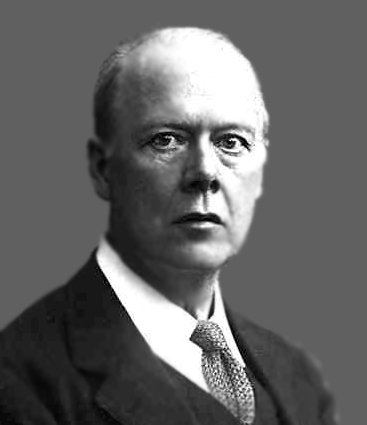 by Houston Stewart Chamberlain (left)
IN these grave and solemn days there is no room for elaborate rhetoric, but for facts only—nothing but facts. Beside the sacrifice of so many lives for the existence and safety of their country, even the eloquence of a Demosthenes would sound empty.
“Facts,” writes Carlyle, “surpass all reasoning; beside them words are a mere stammering and stuttering.” But how are we to arrive at facts? Material facts, indeed, force themselves upon us; but how can we arrive at intellectual and moral facts?
The appalling fact of a world at war we have before us, night and day, but where is the fact that forms the inner reason of this war? Who has brought this war about?
Germany's enemies claim that it was she who broke the peace, and that Europe will not be at rest until Germany has been annihilated. Where must we look for the origin of this wild idea? How is it possible to hide the obvious truth, “the fact,” from the eyes of the millions? To state something to be a fact means that it is a truth. An untrue fact is a thing of nought, “ens imaginarium,” of Kant, “empty form without substance.” Just such a phantom, however, sometimes exercises a great power over the imagination of men. The press, that powerful instrument for spreading the truth, becomes, in the hands of a few unscrupulous persons, a tool for the dissemination of false statements which has no parallel. We realize this forcibly in the war news of foreign papers. Despicable, however, as the use of the press for spreading false reports may be, it is almost harmless compared with the attempts to shape the public opinion of whole nations by lies cunningly planned and systematically circulated.
[…]
It is an established fact that at the present time no statesman can afford to disregard the importance of public opinion. To carry on a war is impossible—west of the Russian frontier, at any rate—unless wide sections of the nation are convinced of its necessity. But since no civilized people would wantonly wish for war, they must be imbued with the growing idea of its necessity—a thing which Richelieu did not find necessary. Here a frightful abyss opens before us, for lo! The clever lie acts as strongly as the truth since it is believed! It is sufficient to obtain the possession of a certain number of widely read and therefore influential papers, and to place them under a uniform management. Within a few years the desired end will be attained. The misleading of a whole people has perhaps never before in the world's history been schemed and carried through in such a crafty, shameless and iniquitous way, as the misleading of England in regard to Germany. It is this misleading information which is responsible for the present war.
From the beginning England has been the driving force. England desired and brought about the war. England caused the estrangement between Russia and Germany; and it was England which incessantly nursed in France the idea of revenge.
Such a policy could only be rendered possible by a systematic and diligent deception of the English people.
It was a handful of men who, in cold blood, for the furthering of material interests, decided upon the course a few years ago. The impetus was given by a king; the intellectual capacity was furnished by a soulless, astute statesman, acting on the old English principle that in affairs of State, hypocrisy and lies are the best weapons; the “management” of the misleading in England was entrusted to a skilful man of the press who was ready to advocate any opinion as long as he profited by it.
[The king was George V, and the man of the press was Visount Northcliffe, owner of the Daily Mail and Daily Mirror. The statesman I'm not sure but my guess is Edward Gray. -cy]
At the time of which I am speaking the latter already owned papers of the most diverse directions. He went on buying new ones until even the London Times, the tendency of which had for a long time been influenced by him, passed into his hands. Today, parading under the title of Lord, which conceals his real name as well as his non-English descent, he does what he will with the English people. One example will suffice.
For years past the reports of the Berlin correspondent of the Times have been a perfect disgrace. What, with the invention of positive and negative lies, has been achieved by this unscrupulous man, who must be held guilty of much of the misery caused by this war, is well-nigh impossible to believe. I have several times asked why the German people did not whip this base vilifier across the frontiers of their country. The reply given was always: “There is no law against lying.”
This is a law that must now be made; liars who endanger the peace of Europe should be hung!
And now, after the forged fact of a Germany eager for war, the true facts: Germany is the sole country in Europe that sincerely wished to preserve peace. In this respect the testimony of a foreigner may be of some value:
For forty-five years I have associated principally with Germans, for the last thirty years I have lived continually in German countries. The love of the German way of living and thinking, of German science and art, sharpened my eyes without impairing my vision; my judgment remained strictly impartial; many things which I did not like when I first set foot upon German soil, I have not yet been able to become accustomed to. Connected with France from earliest childhood, and related to England by ties of blood, I remained free from prejudice.
True, I have always led a quiet life and have not sought to become acquainted with the country and the people by gaping or putting myself in the foreground. At a certain distance objects are seen more clearly than at close range; in quiet surroundings the ear perceives more distinctly than in the midst of confusion.
And this is my testimony:
For the last forty-three years there has not been a single man in the whole domain of Germany who wanted war, not one! Anyone who asserts the contrary is—either consciously or unconsciously—uttering an untruth.
It has been my good fortune to know, thoroughly, Germans from all the various districts and of all classes, from His Majesty, the Emperor, down to the worthy tradesman with whom I have been in daily intercourse. I have known intimately statesmen, teachers, men of science, merchants, bankers, officers, engineers, poets, journalists, public functionaries, artists, physicians and lawyers, but never have I met any one among them who was bellicose.
In England, on the contrary, I found, during my last visits in 1907 and 1908, everywhere a frightful, blind hatred of Germany and the impatient expectation of a war of annihilation.
The absence of any animosity against foreign nations is a striking trait of the German character and of the Germans alone.
They err rather on the side of an exaggerated appreciation of the merits of other nations. [That's for sure! And it is an error. -cy]
Moreover, every German knows that, in view of the geographical position of this country, he has much to fear and little to hope in case of a war. How, then, could a people in whose country industry, commerce and science have, during the last forty-three years, reached an ever increasing degree of prosperity and development, be expected to desire a war which might destroy all the fruits of this labor?
I am going beyond the limits of the space allotted me, and for that reason pass over much, confining myself today to but one point more. I wish to say a few words abut Kaiser Wilhelm.
According to the statement of Germany's enemies, he was the only individual who had it in his power to turn the scale in favor of peace. I have not met the Kaiser often, but whenever I did see him, it was under especially favorable circumstances, outside of court ceremonial, affording an opportunity of exchanging our opinions freely without any fear of possible listeners. Never have I repeated one of the monarch's words; not that he confided secrets to my keeping, but because it is impossible for men in private life to foresee the consequences which a single word might have for a man in such a prominent position. Nor will I now depart from this principle. I feel convinced that I am not committing any indiscretion if I say that two traits in his character have always struck me as most notable because they formed, so to speak, the two “dominants” of all his feelings, thoughts and acts: the deep and ever present feeling of his responsibility before God, and—in close connection with this feeling, indeed, dependent upon it—the energetic, impetuous will to preserve to Germany the blessing of peace.
The power of Germany which owes so much to his personal care was not created to bring on war, but, on the contrary, to force jealous, evil-disposed neighbors to keep the peace.
Does not every act of the Kaiser prove it? Whenever, during the last ten years, the political situation became almost unbearable for Germany's national honor—and England did all in her power to bring about such conditions—he it was, the Kaiser, who, time and again, insisted upon peace. Not that there was such a thing as a war party in Germany; this is one of the Times' falsehoods. There were, it is true, responsible statesmen and soldiers who said, and with reason: if England and her allies want war at any price the sooner the better, But the Kaiser, before his God, could not yield to this argument; the sword was returned to its scabbard.
Wilhelm II had no dearer wish, of this I am fully convinced, than that of being able to say on his death-bed, “I have preserved to my country peace inviolable, history will call me the 'Emperor of Peace.'”
Should God grant the German and Austrian arms victory, a complete, overwhelming victory—for which we all implore Him, including those of us who are not Germans, but who esteem the welfare and culture of civilized mankind more highly than national vanity—then, but then only, will Europe enjoy a lasting peace. Then will the wish of the great and good Emperor, so shamefully betrayed by his equals in rank on foreign thrones, in the end be fulfilled, yes, be fulfilled more gloriously than he could have anticipated, vindicating Germany completely from the calumnies and untruths hurled against her. There will be all the greater reason, then, for calling him the “Emperor of Peace,” for the peace thus obtained will be the original, individual work of Wilhelm II and the army.
v. 2 no. 7 March 24, 1915 page 4
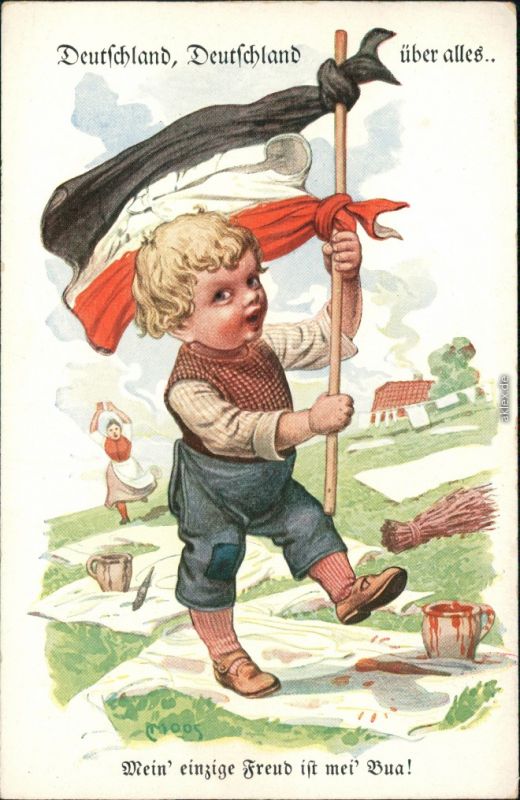 “Deutschland, Deutschland Ueber Alles!”
Dr. Karl O. Bertling
AS a teacher of the German language and a member for several years of the New England Modern Language Association, I protest against the absolutely unfounded allegation that the German National Song: “Deutschland, Deutschland, Ueber Alles,” contains even the slightest indication of German hopes for world conquest.
In this song Germany is characterized exactly as it might be by a teacher of geography within the sober walls of a classroom.
Love of the country as it is—i.e., defined explicitly by her boundary lines, and with not a shadow of a reference to anything outside—love of this country, of German soil, and all it means—is the entire and sole essence of this much-suspected national hymn.
While the supreme value of the life of others may be in pursuit of happiness in this world, to Germans the supreme value of life is supposed to be pursuit of duty first to the cause of their country. From its safety alone may eventually evolve the chance to pursue happiness also.
“Ueber Alles” means that there is nothing more precious in this world than loyalty to one's country. “Ueber Alles” means above everything and involves a valuation in terms of comparison. “Alles” is a neuter, it can never stand for “alle Welt,” or “Alle anderen Völker,” nor is it permissible to translate “in der Welt” by “above or over” all the rest of the world.
Any other interpretation either shows how little the German language is understood in this country, or else it indicates a wilful misinterpretation, and I challenge any teacher of the German language in this country to prove that this translation is not adequate.
The most fanatic German hopes merely for the completion of a Germany which comprehends that which he may claim as German; he abhors that which is not German. To subjugate the USA in the form of conquest, which is the latest scare employed by the yellow press, however, be warned gently of a real surprise which is coming, of another conquest bound to come as sure as fate, namely, the conquest of TRUTH over illusion.
WHY ENGLAND HATES GERMANY
By Waldemar Kaempffert
(The author of the following article is one of the best known writers on economic subjects in America. He is the Editor of “The Scientific American” and his knowledge of actual industrial conditions both here and abroad is unrivaled. Mr. Kaempffert riddles Sir William Ramsay's superficial attempt to explain away British jealousy of German efficiency and points out those strong and sober virtues in the Teuton which has made him so powerful and so much hated by the English.)
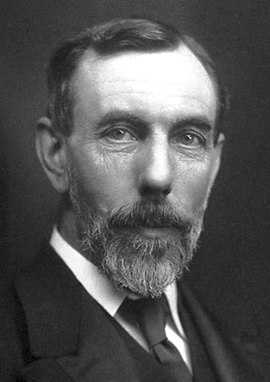 WHEN I first read Sir William Ramsay's (pictured left) article on “German Methods in Commerce” I thought that it must have been written by George Bernard Shaw. “Androcles and the Lion”is no more paradoxical. German methods in commerce—what are they? Systematic cooperation between the State and the merchant, legislation on the basis of a thorough statistical understanding of Germany's industrial requirements and hearty co-operation of government officials with manufacturers, Sir William finds. How are these wicked, dishonest methods to be combated? Simply by “the action of the organized British nation, that is, by the State,” is Sir William's solution. Thus is a German abomination converted into a British virtue. Can anything be more deliciously British? Why not apply the same argument to the conduct of war? The Germans use 42-centimeter howitzers. These are peculiarly heinous, ruffianly, barbaric and unfair weapons. We must prevent their use. How? By employing 42-centimeters against the Germans! In our English hands the gun becomes a fair and sportsmanlike weapon!
Germany has never made any secret of her commercial methods. Dozens of books have been written in French, German and English on the organized efficiency of German commerce, and the German technical journals have revealed even the minutest details. Indeed, if the truth were known, the remarkable industrial development of the United States may be traced to the employment of those very methods which Sir William Ramsay brands as dishonest. It was the United States of America that first evolved the trust and that recognized the enormous commercial advantages to be derived by combination. Germany carried the movement one step further by invoking the aid of the State. Signs are not wanting that we may expect a similar co-operation between government and manufacturing combinations in this country. Germany has taught us that the trusts should be government-controlled—not destroyed.
Sir William Ramsay is a distinguished chemist—one who received his technical education in Germany. Because he is a chemist it is not to be expected that he should know much about business. He tells us that the German nation regards commerce as a species of warfare. That is an antiquated notion of business to which only the English adhere. Scientifically trained manufacturers and merchants abandoned it long ago. They realized the folly of reckless competition—the utter waste of human energy, money and material. Within the German Empire, needless competition has been checked without in the least affecting the rights of the independent dealer and without incurring that popular indignation which was so justly aroused in this country when our trusts forgot that they were servants and not masters of the general public. A Rockefeller would be impossible in Germany, simply because he would be a social outcast.
In competing for world markets with other nations, Germany would gladly arrive at some understanding with other nations. No matter how rich and powerful it may be, it is inconceivable that any German manufacturing company relished the process of dumping shipload after shipload of goods upon a foreign market at ruinously low prices simply to drive out a competitor. It would much prefer to share with other nations the right of selling goods to Chinamen or Brazilians on reasonable terms. But the British still cherish the fixed idea that the markets of the world belong to England, and must be controlled from Manchester, Birmingham and London. If foreign commerce is a species of warfare, the British have made it so. If they had not been beaten by the organizing genius of the German nation, by the intelligent support given by a wise government to German industries, there would have been no war and no article on “German Methods in Commerce” by Sir William Ramsay.
“The war in which we are now engaged is, indeed, a war for the liberation of nations from commercial and industrial brutality,” Sir William cheeringly assures us. He is right. If Germany wins we shall see the dawn of a new industrial era. We shall see German efficiency substituted for British incompetency. We shall see German welfare systems, old age pensions, social and business justice introduced where now there is only squalor, poverty and gloom. Let it not be forgotten that Lloyd George's introduction of the German workingman's insurance system into England was met by an opposition so bitter that it has not yet died down.
The Imperial Council “which takes into consideration all obtainable statistics and as far as possible legislates or endeavors to legislate on the basis of these statistics” is a body which finds an inefficient counterpart in every country. We have a Department of Commerce, a Cabinet, and a legislature, three bodies which should take into consideration the statistical facts of industry and which would legislate accordingly. Unfortunately, we fall far below the German standard in this respect. If legislation is not to be passed upon the basis of statistics and upon an exact knowledge of facts, how should it be passed? Without government co-operation of some kind every industry must languish. If statistical facts are to be ignored, we must substitute blundering for clean-cut, definite, intelligent action.
Sir William Ramsay complains that the “efficient staff of engineers and chemists” of a German manufacturing company “are continually engaged in the problems of utilizing any discovery made in its own laboratories or elsewhere, and making it commercial, whether by securing cheap raw material, cheapening the process of manufacture or creating a public demand for the object to be manufactured. … All this is legitimate; but the maintenance of a trained legal staff, not merely to advise as to the validity of patents, but to advise whether the infringement of another patent is likely to be successful and whether it may not be possible by infringing a patent so to saddle an opponent with legal expenditures as to break his competition is not easily defensible.”
Sir William evidently knows very little of patents and still less of the German patent law. The methods which he condemns are peculiarly American. And to the credit of Americans be it said that they realize the injustice of plunging a weak rival into a ruinous patent infringement suit simply for the purpose of crushing him financially. Patent lawyers, judges and manufacturers are in accord that the American system which lends itself to the abuses described must be modified. But modified how? Curiously enough, we are to approach the German system. In this country at least it is recognized that the German patent law is about the fairest which has thus far been devised. While it would not be impossible for a German manufacturer to ruin a competitor by embroiling him in patent litigation, the risks are too great. Let it be remembered that in German courts the defendant who wins may saddle the plaintiff with not only the court's costs, but with all his own costs as well. What is more the German government practically guarantees the validity of its patents—something unheard of in the United States. As a result all the financial burden, all the legal burden is thrust upon the plaintiff. In other words, a rich plaintiff must be prepared not only to fight a defendant patentee, but the German government that stands back of him. If we had a similar system in this country patent infringement suits lasting from five to thirty years would be unknown.
[…]
It has remained for Sir Willaim Ramsay to discover that “The German nation as a whole is completely unworthy of trust.” Canada is supposed to have the best immigration laws of the western hemisphere. She deliberately excludes what she conceives to be undesirable southern Europeans, fearing that they will not blend well with the Anglo-Saxon strain in her wheat-raising farmers. To encourage the right kind of immigration she has established in the principal northern European cities, agencies which alluringly set forth the beauties of life in Canada. Not only Finns, Englishmen, Irishmen and Northern Frenchmen are thus induced to immigrate to Canada, but the very Germans whom Sir William finds racially dishonest and untrustworthy.
It is strange that South Americans and Asiatics have not discovered the trickiness of the Germans. They have been dealing with the German for fifty years and still remain blind to his wickedness. He learns their ways of doing business and adapts his ideas to theirs; he studies their language; he adapts his financial credit system to their financial needs; he makes it as easy for them to do business with him as possible. The United States government has published many a pamphlet in which it has set forth the efficiency of the German in foreign markets and recommended an adoption of his method by Americans. Is it possible that we, too, are dishonest? No one has yet accused the Germans of being a nation of fools. But only fools could conduct themselves in commerce by violating commercial obligations in the manner that Sir William charges. No nation can build up by chicanery a foreign commerce second only to that of England, in the short space of four decades. Sir William is right when he concludes “that commerce should be co-operative and not competitive.” It is that very lesson which Germany has driven home. Some day competition in the markets of the world will be regulated by international agreement. The first nation that will speak in favor of international regulation will be Germany; the last, England.
- 944 views
Comments (3)
Two email comments
carolyn
From Charles K:
"Are we secretly England's ally?"
Not just an ally. A veritable vassal state! Lyndon Larouche was/is not a crackpot. Google the "Mt. Pelerin Society."
From Kevin H:
"It occurred during the Boer War."
St. Louis Star confirms Schrader article
carolyn
Found in the May 26 issue of THE FATHERLAND, a follow-up article from F. F. Schrader informs that the St. Louis Star of May 2, 1915, printed the following:
Roland G. Usher, professor of history at Washington University, told The Star today that he knew of a secret verbal alliance between the United States and the Allies opposed to Germany and Austria in the present war.
“I did not learn my facts from President Eliot,” said Professor Usher, “and I am unwilling to state where I got my information. The alliance does not bind this country to assist the Allies, but is a verbal agreement binding this government to respect certain claims of the Allies. We entered into the agreement in 1897 when McKinley was President of the U.S. By the terms of the understanding we [England] were to be given certain rights in America, which I have outlined in my book, 'Pan-Germanism' and further outlined in 'Pan-Americanism.' When the Spanish-American War broke out England lived up to her part of the agreement by seeing to it that we were not interfered with.”
More from same Schrader article
carolyn
The same article further states:
“Mr. Usher's statements are confirmed by various incidents. The American people have not forgotten the speech of Commander Simms, U.S.N., at a Lord Mayor's banquet in London during a visit of an American naval squadron to England under President Taft, in which [Simms] declared that the American navy would be found fighting side by side with the English navy in the next war against the common enemy.
For this indiscretion in betraying State secrets, Simms was temporarily squelched, but soon after was entrusted with a higher command than he had held before.”
Also:
"Our present Ambassador to the Court of St. James, Mr. [Walter Hines] Page, had barely arrived before he made a speech emphasizing the close ties: 'The bond between us is a bond of blood. I say, with due respect to other bloods and other nations, that it is with us who speak the language of Shakespeare that the responsibility of ruling the world must rest.' And: 'The Pilgrim fathers were not only God-led men, but God-led Englishmen.'
And:
The alliance with England is in the air! Men like Roosevelt, Eliot, Bacon, Harvey, Gardner, Page and Lodge are more English than American. […] There is in the President's cabinet not a single American of German descent, but there are two members born under the English Crown: Franklin Knight Lane, Secretary of the Interior, a native of Canada; William Bauchop Wilson, Secretary of the Department of Labor, born in Blantyre, Scotland.
Plus:
"According to the New York World, April 28 last, Sir Herbert Beebohm Tree proclaimed on the stage of Drury Lane Theatre in the presence of the Queen of England and the American Ambassador, as well as a huge audience which included many members of the royal family, that 'The President of the United States may be neutral, but the people of the United States are with us in this fight. They are our allies!' His words were followed by a tremendous outburst of applause during which many people turned and looked pointedly at Ambassador Page.”